
Understanding Deteriorated Mortar in Stone Fence Posts
This past week, we took a look at a granite stone column that’s used to support a fence. This particular column has pretty severe mortar joint deterioration. It’s actually already been repointed since the initial construction though. Posts like this and chimneys above roofs, for example, deteriorate faster. They’re exposed or more sides and unlike a large brick or historic masonry wall, these columns stand up like small posts against the elements in defiance. They have more exposure and they take more wear.
In historic times, going back hundreds of years, a figurehead was built on most warships and even merchant ships . The figurehead was a large hand carved wooden decoration at the bow of the historic ships. The design of the figurehead was intended to embody the spirit of the ship. These figureheads were meant to take the full brunt of the weather and the harshest elements as they led the ship through bad conditions. Chimney and freestanding masonry posts like this are exposed to the harsh elements, like a figurehead in an old warships.
One of the terrific qualities of masonry is that it is generally resistant to the type of deterioration driven by exposure to ultraviolet rays in sunlight. Wood, for example, in contrast deteriorates very quickly when exposed in exterior installations because of its exposure to ultraviolet. Here though, masonry, both brick and stone work, are almost completely unaffected by exposure ultraviolet rays.
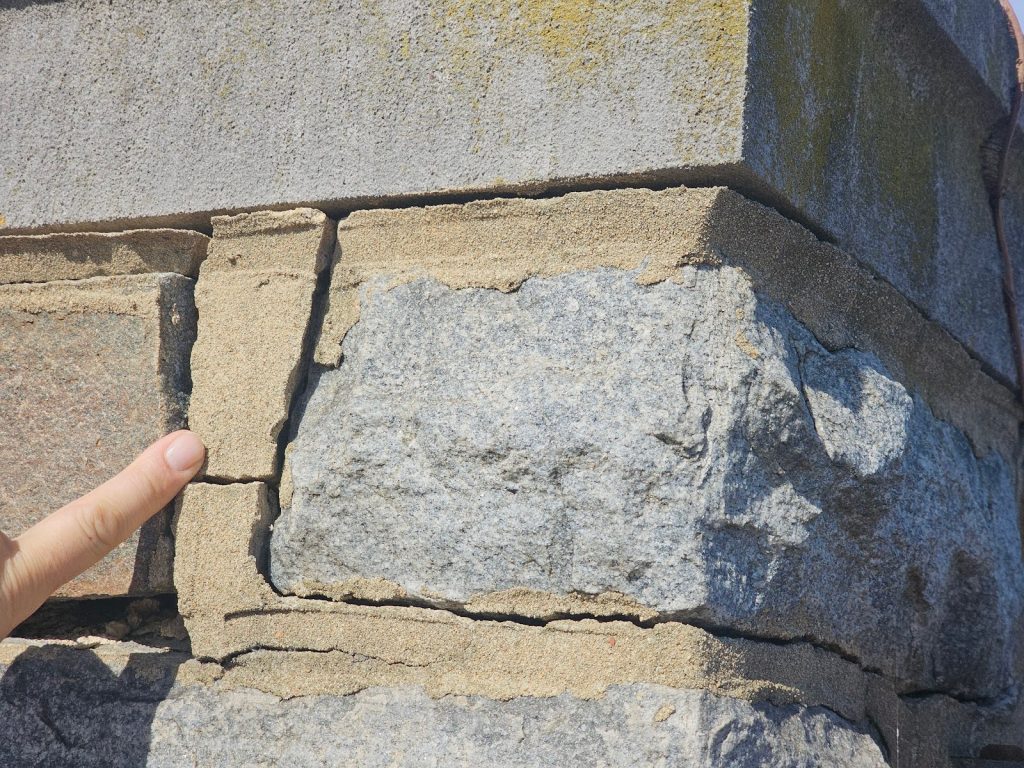
If you look at the vertical mortar joint that I’m pointing to in the picture above, you can see that it’s basically got a dark shadow all around it, plus a horizontal crack running through the middle. Even though this is not the first application of mortar and repointing at this area, this particular mortar has also deteriorated. That separation of the mortar joint repair here is likely related to internal typical forces of movement and the bondability and compatibility of the mortar.
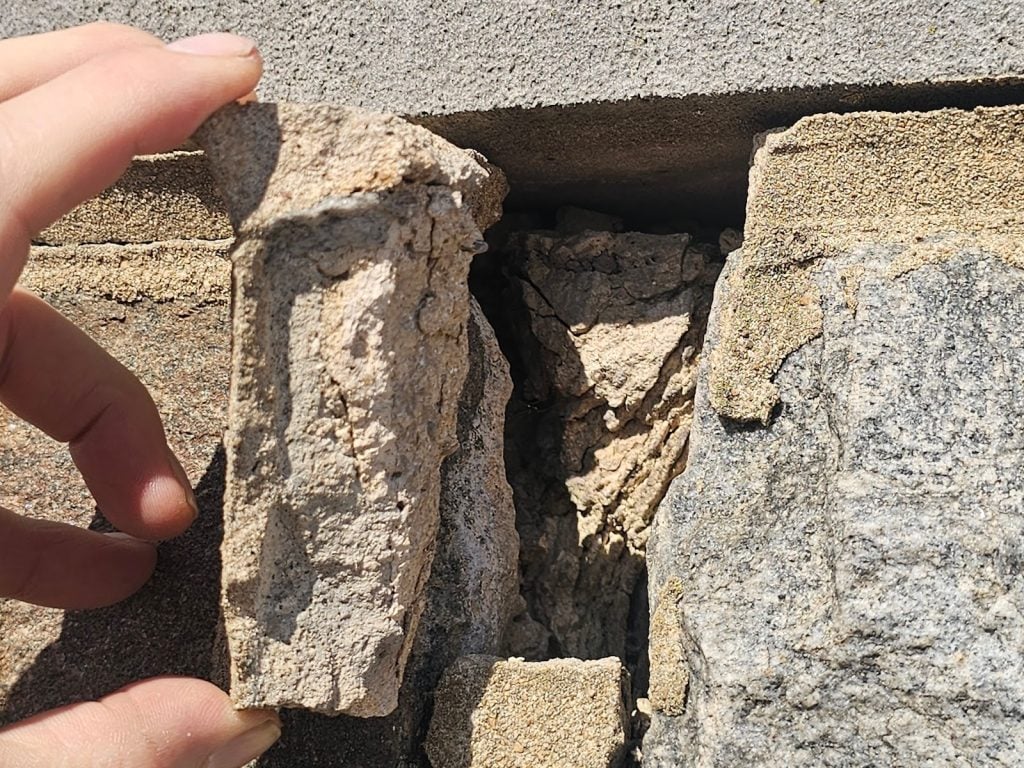
A zoomed in view of the mortar joint shows the internal deterioration closely. As the mortar has aged, it’s lost its internal cohesion. Generally, in different types of mortar there are different types of elements for binding. Mortar is made up of more than just the binder itself. In fact normally there’s as much aggregate and sand as binder, or in most cases there’s even more aggregate and sand than binder.
Aggregate and sands are generally composed of base materials like silicon dioxide, quartz, hematite, and feldspars and arkose. In the case of silicon dioxide and quartz, they’re very similar. Silicon dioxide is the chemical compound, but quartz is the crystalline structure of that chemical compound. Together, quartz and feldspar are often referred to as akose.
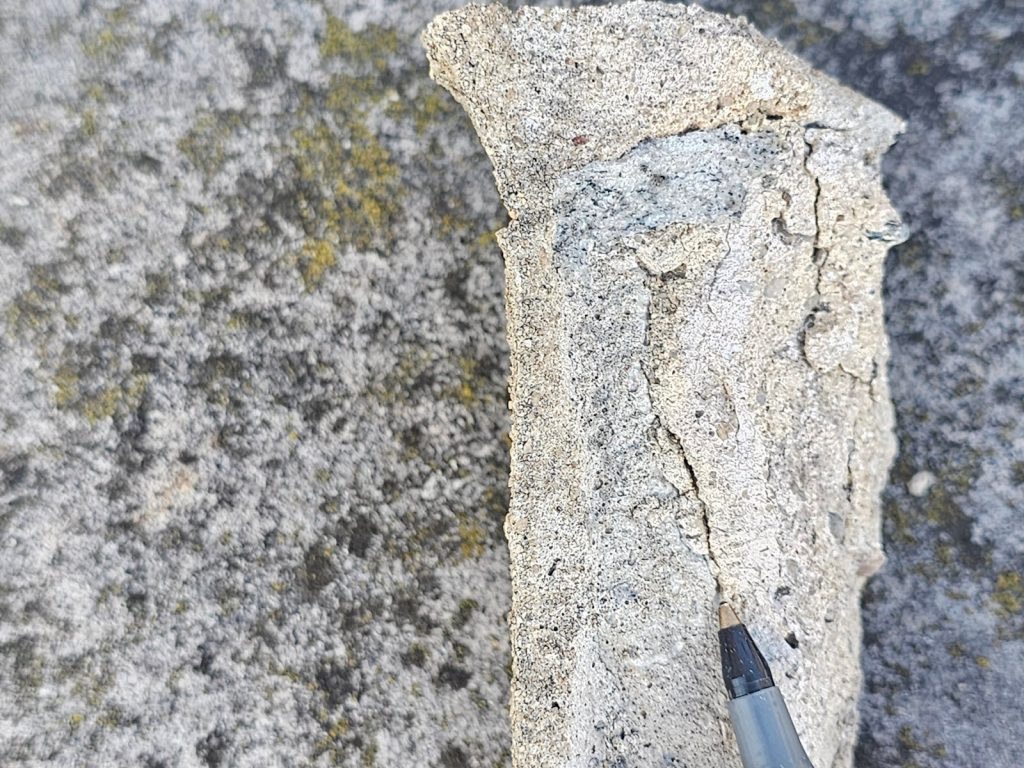
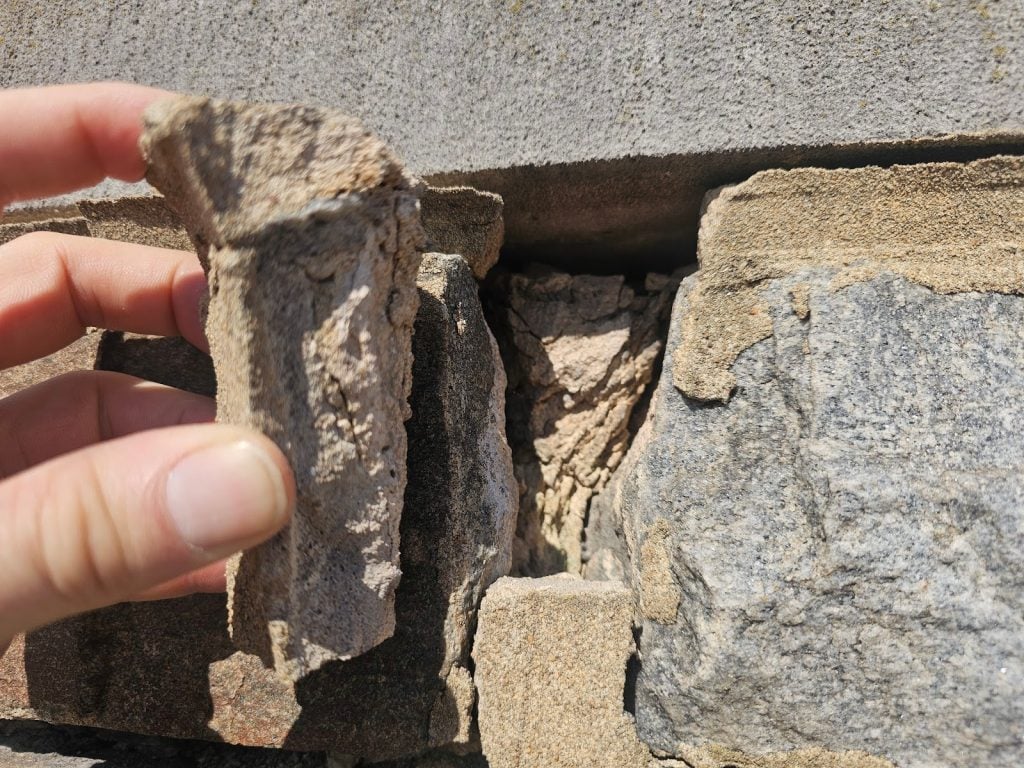
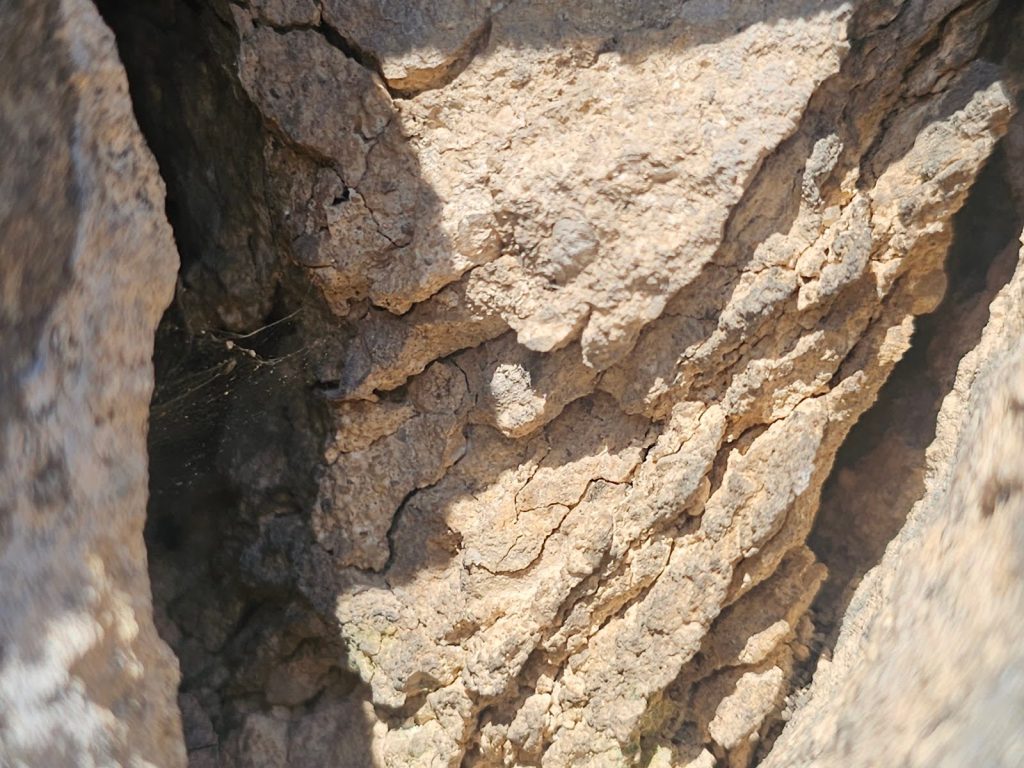
In the next picture below, you can see an example of where some of the big chunks of mortar are basically delaminated and loose. They’ve lost almost all cohesion to the substrate. In some cases, because this is a stone masonry assembly, and built with a rough ashlar stone, yet retains some rubble shape qualities, the mortar joints are very large. This particular chunk happens to be several cubic inches of volumetric space.
If repointing and general upkeep and maintenance happens on a more proactive schedule, damage can be mitigated. Essentially, investing a little bit before things start falling apart is less expensive, overall, than waiting until the problem becomes so bad that it’s led to destruction of a masonry construction. That takes into account not just cost or investment in the instance of ipkeep repair, but many instances of ongoing small repair.
For example, we think of it a little bit like the analogy of the maintenance on a truck. On a large construction truck, changing the oil might cost around $100. You may have to do that several times a year. Over the course of 10 years, you may change the oil 40 times. All together that might cost $4,000. But replacing the motor on one of these large construction trucks may cost $10,000. Considering the cost comparisons, we just recommend changing the oil as you go. It saves so much money.
It’s the same thing with general mortar deterioration, it makes sense to start upkeep early on in the life cycle of masonry. Particularly with historic bricks, they should at least be checked. They’ve already been around for a hundred years, now and even if they don’t show signs of serious damage or deterioration at the surface, it is definitely worth having an experienced contractor just take a look through things to look for areas of needed upkeep and maintenance.
We can Help
Our company focuses on historic restoration more than modern building upkeep, maintenance, and construction, but our company understands both types of construction very well and a full picture well-rounded approach is needed in any niche in the construction industry. Although we focus on historic restoration, repointing, tuckpointing and historic brick repair, our company also has technical knowledge and competencies in the areas of modern and contemporary construction as well as we become one of the leaders in that area of the market today. Understanding both historic and modern or contemporary construction is useful because both aspects help understand the challenges and potential solutions for challenges in building science and construction.
We can help with a variety of historic masonry restoration needs and upkeep, from modest tuckpointing and or repointing to complicated and extensive historic masonry restoration. Infinity Design Solutions is a historic restoration specialist contractor specializing in both historic masonry restoration such as tuckpointing our repointing, and brick repair. If you have questions about the architectural details or facade of your historic building in Washington DC, reach out and say hello and if we can help we’ll be glad to assist you. You can email us or call us on the telephone at the following link: contact us here.