
Building envelope security inspection
The Washington DC of today is nothing like it used to be. The city has gone through cycles. These cycles have been driven by policy, but to make it simple, it comes down to the economics of the area. In the 1970s, even up through to the early 2000’s people started installing security bars at the majority of ground and basement level fenestration points. These are locations where there’s doors or windows.
In the past, cycles of high crime go in coincidence with disparity of wealth in the neighborhoods of DC. The houses are very valuable and throughout points in their history they were occupied by people of wealth and affluence. Today, even though Trump insists there is lots of crime in DC, by almost every metric, crime has gone down significantly. In fact, with all the shooting sprees happening in rural areas, related to the gun epidemic in the United States, it feels safer in the city, to many.
The national leadership is currently gambling on broad changes that will possibly derail most people’s economic trajectory. Because of these changes, it’s likely that some of the risks and areas of concern related to security will repeat or reoccur. As prices increase and earnings decrease, the weakest among us will be hit the hardest. They will look for anything they can find to survive. In the past, when there were many vacant buildings in Washington DC. Naturally people used those buildings for unauthorized temporary housing.
It’s particularly common where the buildings are not well secured. Where buildings are dilapidated and not maintained, it’s often relatively easy to find an entry point into the building. We often talk about entry points like this often for rodents and animals, but the concern also applies to door and window locations for humans as well.
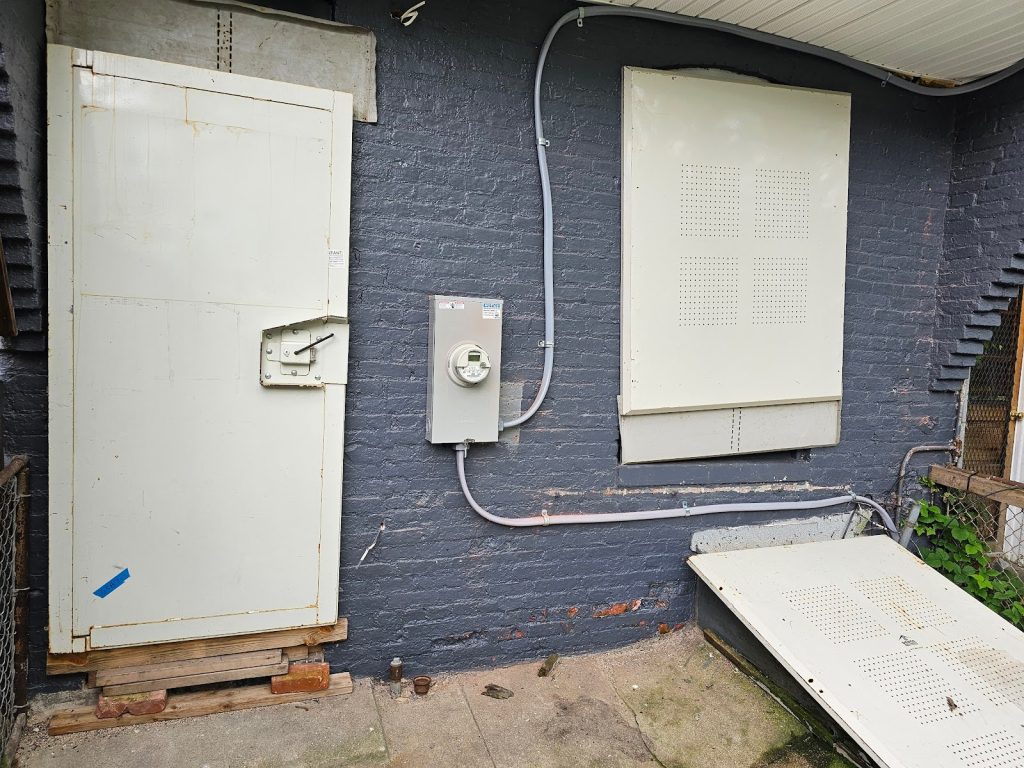
The building facade shown below is at the rear of a relatively typical row home. There are buildings like this across the majority of the historic neighborhoods in Washington, DC. The building is built with typical common bricks at the rear and has a simple layout with a single large window and a single entry door. The upper floor has been extended back about 4 ft to give extra space to the top floor rear bedroom and has two windows at the rear facade. The windows remain intact, but they have a large metal panel that covers not just the glass of the window itself but the frame and the exterior casing surrounding the window frame.
When these panels are positioned like this and will secure it makes it very difficult for someone to pry their way into or break the glass to get into a building.
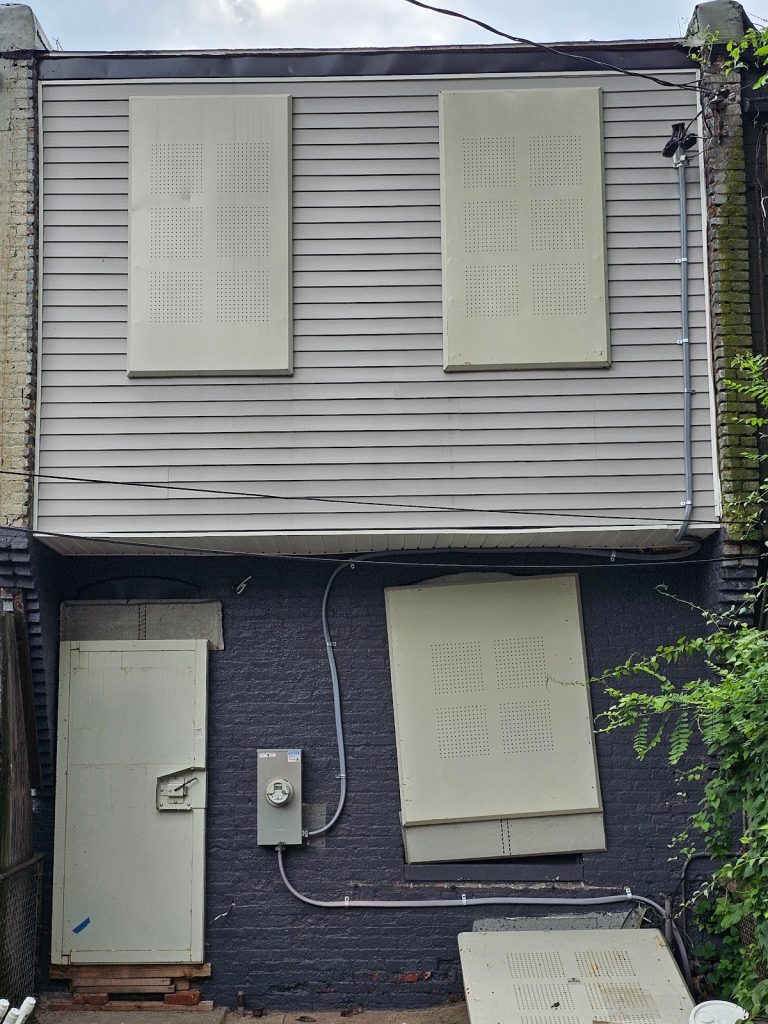
The panels at the windows are fixed in place. The panel at the door offers similar protection but is also operable. Essentially, it can be opened and released by opening a padlock. Padlocks can be a security weak point. For security purposes the strength of the shell is like a chain, only as strong as its weakest link. Usually, a padlock can be essentially broken with a bolt cutter or power tool. However, in this case it is different. The guard protects the padlock by enshrouding it from all sides, other than the key cylinder, with a steel encasement.
You can see the assembly in the photo below. Once the padlock is released the lever can release the panel.
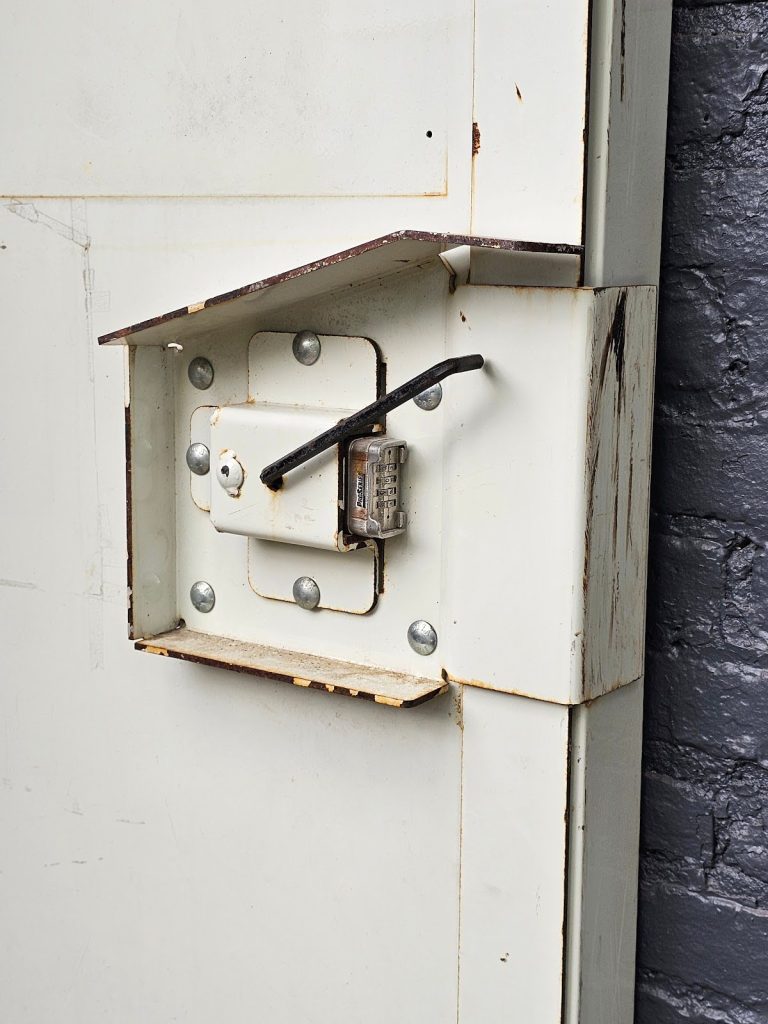
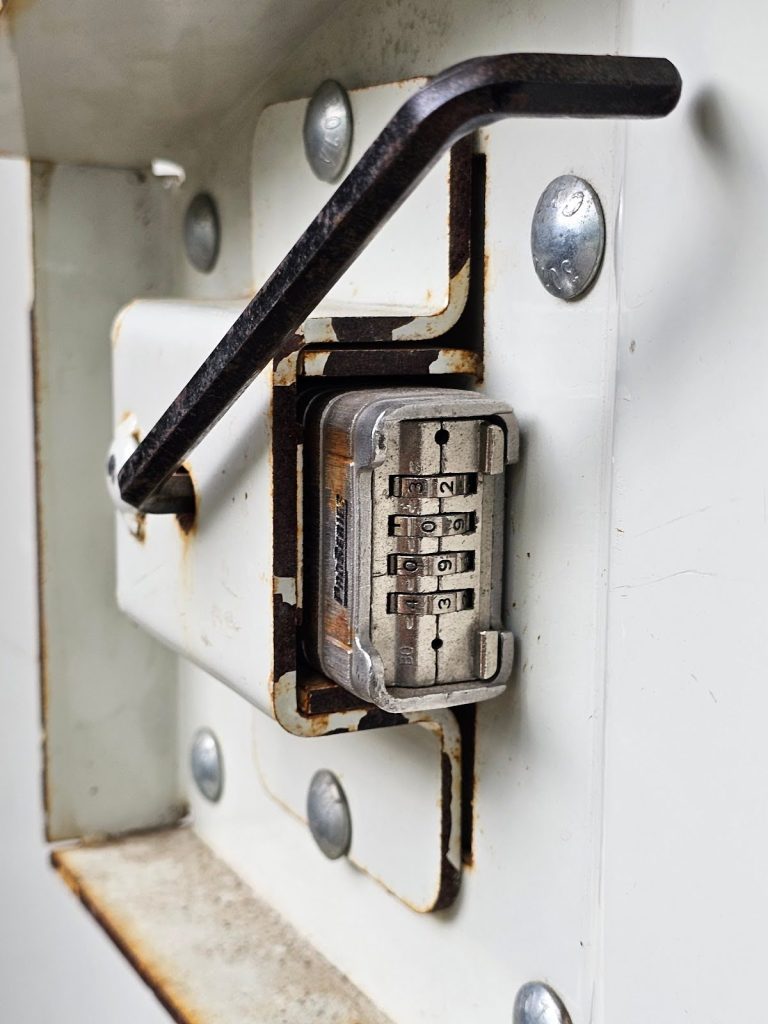
The next photo shows a closer view. Several styles of suitable padlocks can be used, with a standardized comparable size. In this example they have used a number roller instead of a more typical key cylinder.
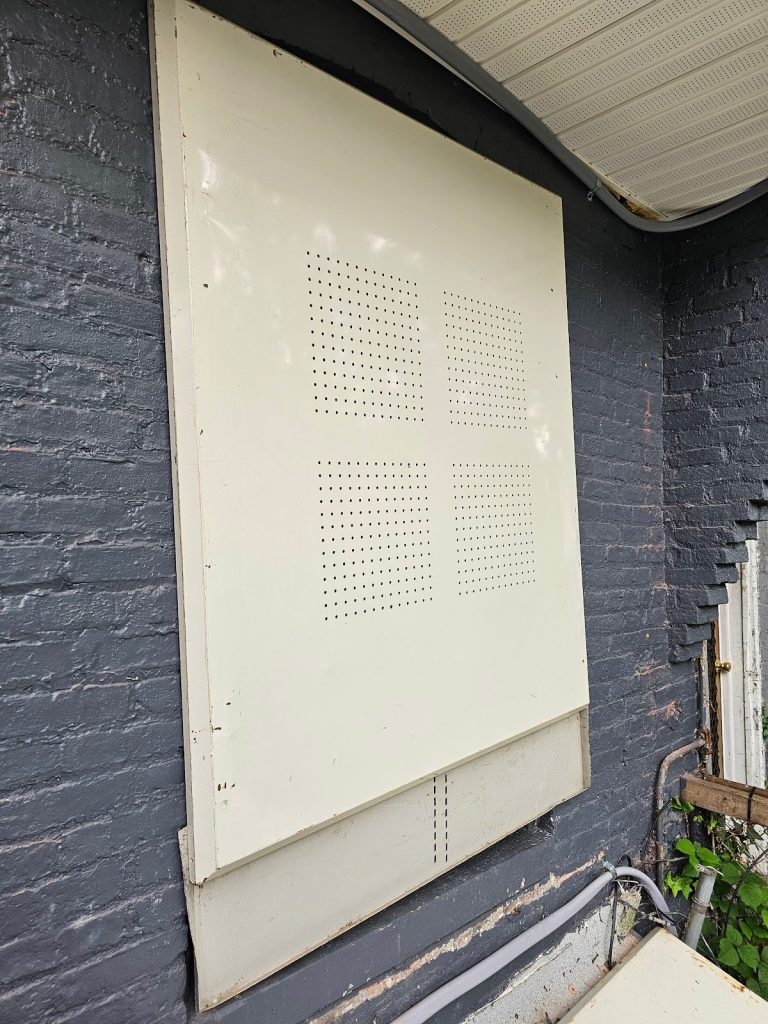
The perforations that are set into the panels allow for condensation to evaporate naturally. It helps to provide this kind of ventilation to deter excessive buildup of condensation. Otherwise, as is similar in issues of masonry restoration and repointing, when moisture builds up, can lead to damage and deterioration of the masonry. Just as a side note, this particular type of masonry, shown here in the picture below happens to be a historic common brick, found at many of the rear facades of the building in the historic areas of Washington dc. We often work in restoration and repointing of this type of masonry.
As a building type, masonry buildings are generally much tougher than stick frame and or modern track home manufactured type housing buildings. It just leaves these weak points that are still accessible and or at risk from a security perspective. Not all buildings are the same, and this one happens to be a bit of an anomaly because the power supply here is installed at the rear of the building instead of the front. In DC it’s more common for buildings to have power run through the front of the building instead of the rear.
We can Help
Our company focuses on historic restoration more than modern building upkeep, maintenance, and construction, but our company understands both types of construction very well and a full picture well-rounded approach is needed in any niche in the construction industry. Although we focus on historic restoration, repointing, tuckpointing and historic brick repair, our company also has technical knowledge and competencies in the areas of modern and contemporary construction as well as we become one of the leaders in that area of the market today. Understanding both historic and modern or contemporary construction is useful because both aspects help understand the challenges and potential solutions for challenges in building science and construction.
We can help with a variety of historic masonry restoration needs and upkeep, from modest tuckpointing and or repointing to complicated and extensive historic masonry restoration. Infinity Design Solutions is a historic restoration specialist contractor specializing in both historic masonry restoration such as tuckpointing our repointing, and brick repair. If you have questions about the architectural details or facade of your historic building in Washington DC, reach out and say hello and if we can help we’ll be glad to assist you. You can email us or call us on the telephone at the following link: contact us here.