
Decorative Planters Problems on Masonry
We definitely recommend against putting unnecessary or additional fasteners or bolts or mounting points into historic brick masonry facades. In some cases, though, if done right (and doing it correctly is important), it can look nice. Here in Washington DC, right around the corner from our office, a group of buildings were decorated with a large set of hanging plants. The plants happen to be artificial, but they look real enough to improve the overall aesthetic. You can see the view, walking down the sidewalk. Most buildings in DC, particularly at historic row homes, have masonry facades, with several architectural accents.
In general, we appreciate historic masonry buildings. We think they generally look pretty good, without even having added adornment and decoration. It happens sometimes hough that a little bit of extra decoration can actually look okay.
These buildings are a bit taller than the average buildings here in Washington DC. Rowhomes generally range from about 2 to 3 levels. Sometimes they’ll have an extra level tucked away behind a mansard roof in what could be called an attic. In some cases, that attic space can actually have a significant head clearance to work as an additional level. Sometimes it’s just a extra attic level that’s been converted to a loft. In other cases it’ll be a good storage space. In some cases it’ll even be converted to something more useful like a home office.
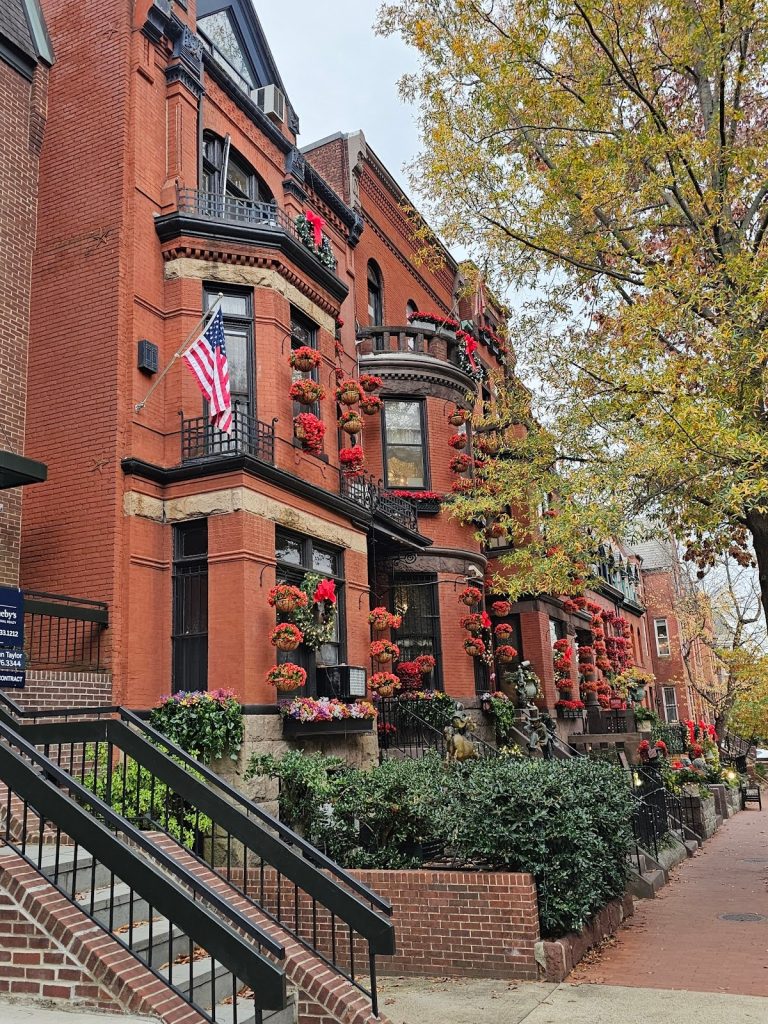
In this case here, at this grouping of buildings, there may be examples that have as many as five levels. That particular counting includes a basement level and an attic level. It does look though that the attic levels have sufficient space that you could even walk in them. Having that amount of space and attic isn’t common, but there are several examples of large attic spaces here in Washington DC. This is an occurrence or a phenomenon that’s pretty unique and specific to Washington DC. Other flat roof buildings generally don’t have that much clearance outside of historic row home areas like Washington DC.
Often, when these historic brick room homes were built, they were built in groups together. Generally groups that range from about three to five row homes would be built by a single builder. There are exceptions of course. In some cases a particular builder might just build one single rowhome. In other cases they might build way more than just five buildings. In some cases entire blocks were developed by a single builder, even in historic times.
One of the reasons that it wasn’t as common in historic times has to do with financing. Today, there is a robust lending and investment system here in the United States. That system may erode over time, particularly with very recent changes, but over 100 years ago at the time these buildings were originally built, it hardly existed at all in the framework that we are most familiar with. It was relatively new and burgeoning then. The framework that we’re most familiar with came about after World War II.
Before that it was rare for single families to be able to get loans to afford major modifications to a building, the construction of a new building, and or even the purchase of land. Instead people would generally have to save for a long period of time and then use their savings to incrementally build and develop a property. The system we are most familiar with ran from about the mid 20th century to about the first half of the 21st century. Overall, this system may last for about 100 years.
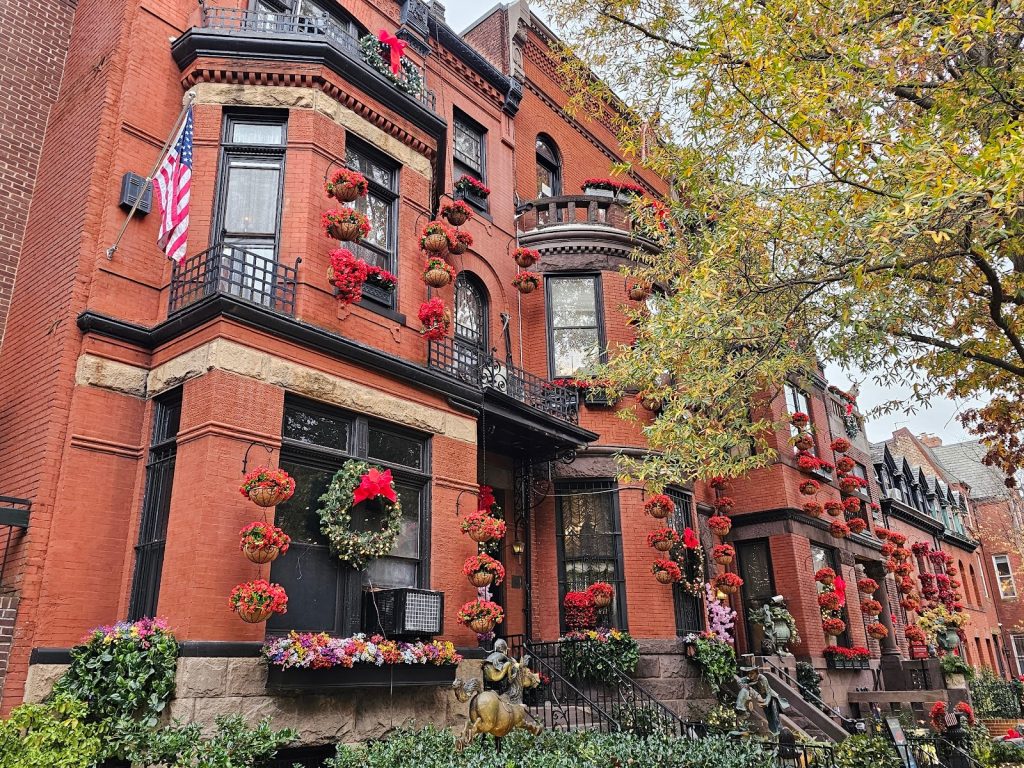
As a company, we focus on historic masonry restoration. We take buildings like the building shown here and we repair and renovate the exterior masonry facades to keep them in good shape. Keeping these buildings in better shape has a comparatively very low cost and a very high return on investment because it’s much cheaper to keep a building in decent shape than it is to repair once it has begun to deteriorate.
Once deterioration is significant, it can be exorbitantly exponentially expensive to repair and save the building. The difference is nonlinear, meaning that the damage increases at an exponential rate. So it’s pragmatic to simply be proactive and have a company like ours who takes this work seriously do incremental upkeep and maintenance. Doing it the other way where you are reactive instead of proactive, can be extremely more costly and have a very negative ROI. It just makes simple sense to care for these buildings when they need it instead of after it’s too late.

So even though our company’s real focus is not directly related to financing, it has an important impact on the history of this classic architecture. We’ll talk a lot more about this in this coming week’s blog article.
We can Help
Our company focuses on historic restoration more than modern building upkeep, maintenance, and construction, but our company understands both types of construction very well and a full picture well-rounded approach is needed in any niche in the construction industry. Although we focus on historic restoration, repointing, tuckpointing and historic brick repair, our company also has technical knowledge and competencies in the areas of modern and contemporary construction as well as we become one of the leaders in that area of the market today. Understanding both historic and modern or contemporary construction is useful because both aspects help understand the challenges and potential solutions for challenges in building science and construction.
We can help with a variety of historic masonry restoration needs and upkeep, from modest tuckpointing and or repointing to complicated and extensive historic masonry restoration. Infinity Design Solutions is a historic restoration specialist contractor specializing in both historic masonry restoration such as tuckpointing our repointing, and brick repair. If you have questions about the architectural details or facade of your historic building in Washington DC, reach out and say hello and if we can help we’ll be glad to assist you. You can email us or call us on the telephone at the following link: contact us here.