
Structural Issues from a Tree Through a Beam Pocket
Here, in the picture below, we show some of the beam pockets that we looked at this past week. On a closer view, you can see directly into the beam pocket. In our weekly article on masonry and historic building restoration, we pick up here at the second and final part of a two-part series on historic beam pockets and trees that grow into these beam pockets. The condition of trees growing into beam pockets happens if they are left without care and proactive maintenance. As we explained last week, this wall, as originally intended, was built to serve two different buildings. Essentially, the majority of the historic row homes here in Washington DC are built side-by-side.
When they’re built at the same time, there’s just one masonry wall that is shared between two buildings. This type of configuration essentially makes the construction a bit cheaper because by sharing the walls, you are effectively only paying for one side wall per building not two. Of course there are exceptions such as the end of the rows or the end of the groupings of buildings where the first or last of the building may have the full cost of construction for both walls.

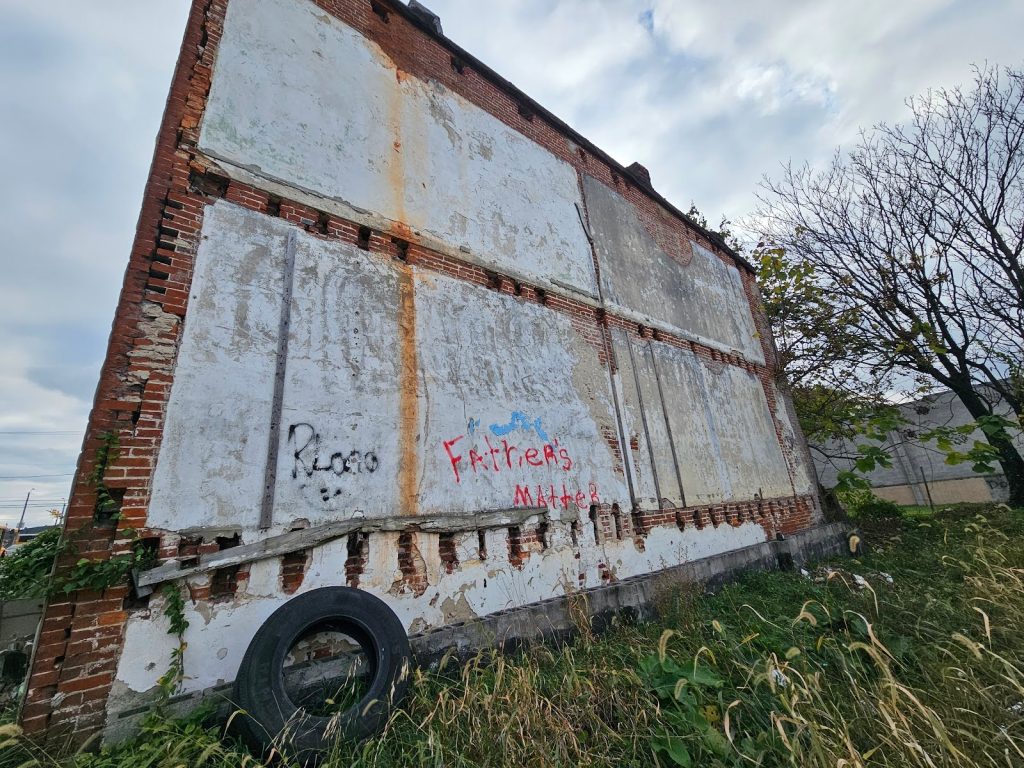
If you happen to notice in the picture below, you can see the place that was once on the interior of an adjacent row home. This plaster is installed in small square patches. These patches have perimeters or borders around them of exposed brick where the plaster wasn’t applied. The plaster wasn’t applied at those areas because those areas were part of unfinished spaces. Some of these unfinished spaces are in the interstitial void area of the framing. However, at the top of the building and the bottom of the building, there’s an area of attic and crawl space, respectively.
At the front area of the building, in the picture below, the plaster section all the way down in the crawl space is a bit hard to explain. It looks like the plaster was applied before the floor system was installed, at that location. At the upper floor areas instead of field building temporary scaffolding, it looks like they waited until the floor system was installed before applying that upper wall plaster. That makes logical sense.
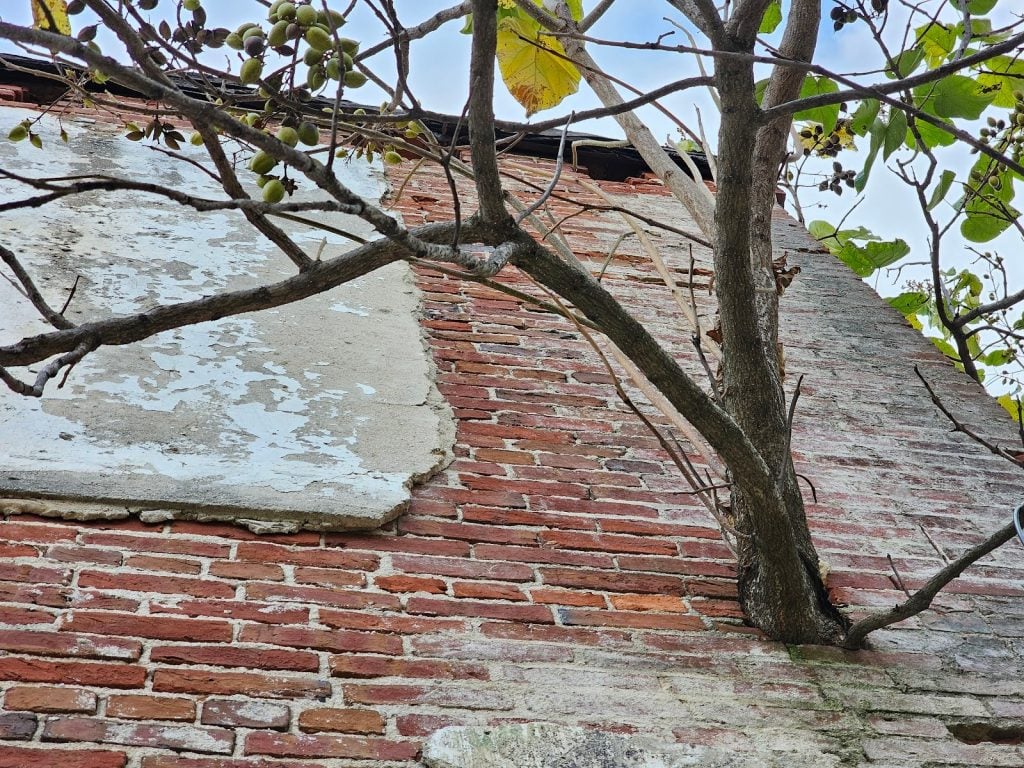
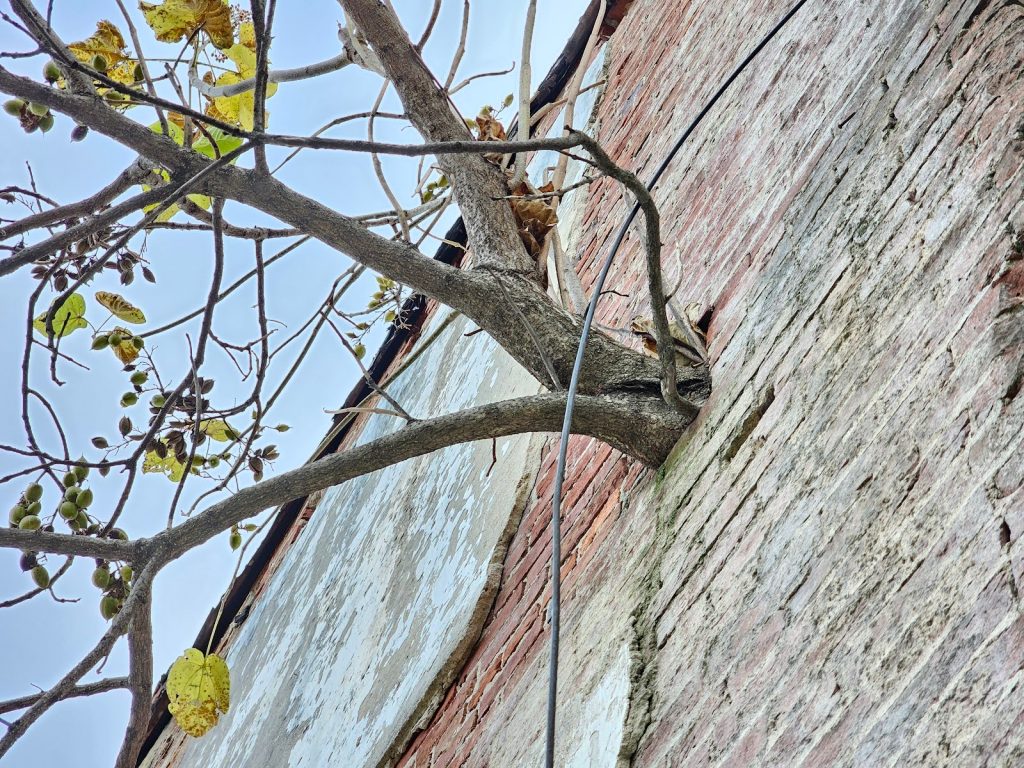
The picture below shows a closer view of the base of the large empress tree growing out of the wall. This isn’t the only tree growing out of this wall though. There’s another smaller tree in the lower area that is also shown in the next picture farther below. As the tree grows, it will expand with great force and pressure. That pressure will eventually destabilize the wall. Trees like this could get large and heavy, even where they are restricted, bounded, by openings in brickwork. Eventually, without upkeep or maintenance or any type of mitigation, trees like this can bring the entire building to destruction.
The next picture shows a tiny portion of the base of the upper tree at the top of the picture, and a different smaller tree growing out of a crack or space between the back of the original part of this building and a smaller attached stairway. In many cases, additions have been added to these historic buildings. Over time the use of the buildings have changed. As families grew, it became useful to have a bit of additional space. The backyards, in most cases, provided a bit of additional space for rear additions and expansions. In some cases, sleeping porches were built on the back of these historic brick buildings.
The rear sleeping porches were generally built with relatively lightweight types of wood assemblies. In some cases, as time went on, people changed these sleeping porches into interior spaces by enclosing the outer walls. Adding sheathing and or siding to the exterior walls adds a significant amount of weight and in many cases the original framework wasn’t built sufficiently to hold all that extra weight.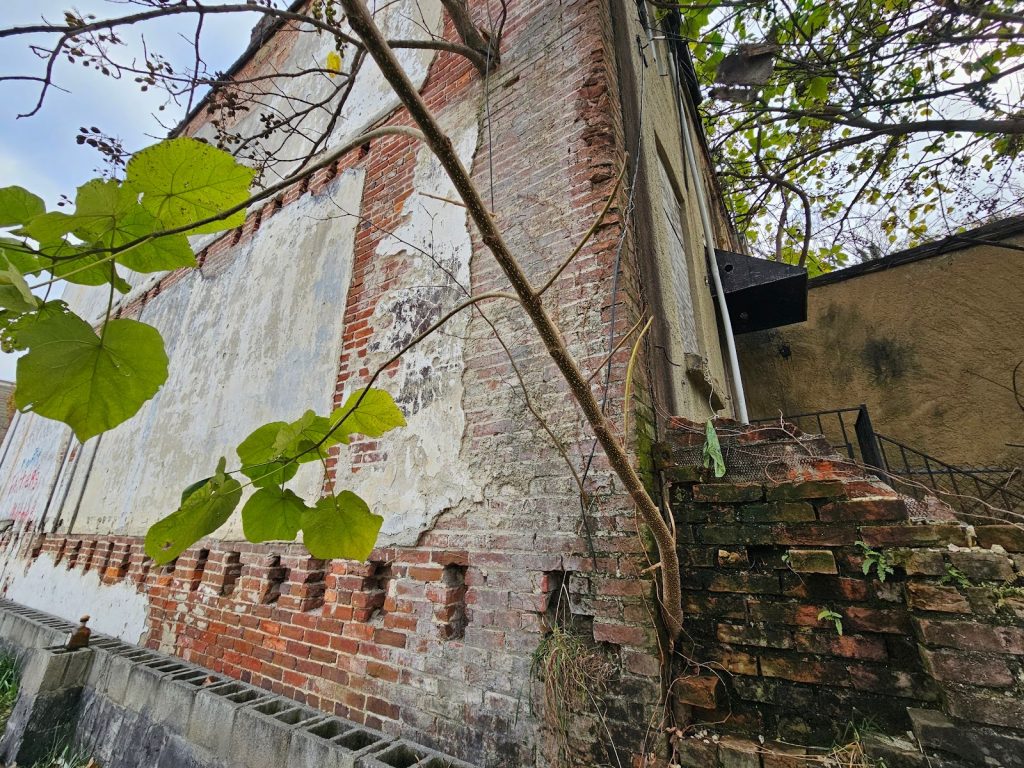
Here, as the lower sapling grows and expands, it weakens and will destabilize and push the brickwork apart.

This particular type of tree has relatively moderate or weak wood, but it grows very quickly and even though the wood grain isn’t particularly strong, it is strong enough to push thousands of pounds of materials apart.
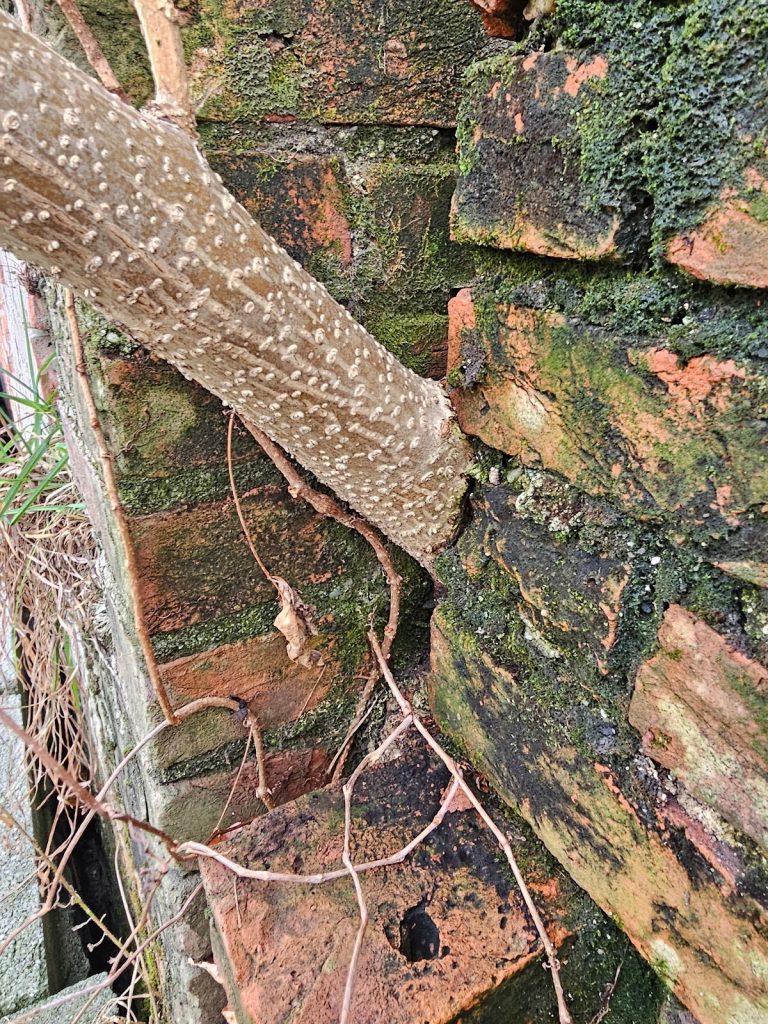
You can see the base of the trunk of the sapling being pinched between the brickwork pulls up even though it looks like the tree is growing around the brickwork, it’s also pushing the brickwork apart. In time, it will lead to destruction.
The larger tree growing out of the upper area has been here longer and although it looks like it’s growing slow and passive, it is setting roots deeper into the masonry partition. This, as well, will lead to destruction and collapse of at least a part of the building if left unmitigated. It needs proper upkeep and restoration to maintain this building. We talked about repointing and the need for routine repointing as the decades go by in the life of a masonry building. Here as well, these trees need to be removed.
We can Help
Our company focuses on historic restoration more than modern building upkeep, maintenance, and construction, but our company understands both types of construction very well and a full picture well-rounded approach is needed in any niche in the construction industry. Although we focus on historic restoration, repointing, tuckpointing and historic brick repair, our company also has technical knowledge and competencies in the areas of modern and contemporary construction as well as we become one of the leaders in that area of the market today. Understanding both historic and modern or contemporary construction is useful because both aspects help understand the challenges and potential solutions for challenges in building science and construction.
We can help with a variety of historic masonry restoration needs and upkeep, from modest tuckpointing and or repointing to complicated and extensive historic masonry restoration. Infinity Design Solutions is a historic restoration specialist contractor specializing in both historic masonry restoration such as tuckpointing our repointing, and brick repair. If you have questions about the architectural details or facade of your historic building in Washington DC, reach out and say hello and if we can help we’ll be glad to assist you. You can email us or call us on the telephone at the following link: contact us here.