
Concrete Shingles for Column Caps: Benefits, Design, and Installation
Today we’re going to look at something that’s really interesting. It’s a “trompe l’oeil”. That is an architectural term that means something used in architecture or construction meant to deceive the eye. At this particular property line there are several brick columns. Like most types of historic brick, these bricks were also susceptible to moisture and precipitation in a way that’s more accelerated than contemporary or modern bricks. Modern bricks are fired at a higher temperature and generally have a slightly higher or significantly higher amount of vitreousness which protects them from permeability and helps them avoid excessive hydration.
Historic bricks were low temperature fired and had a higher degree of susceptibility. In the case of older, more historic bricks, it really helps to have a covering on them that can either be sacrificial and or long-lasting to prevent the filtration or absorption of water at the top of the columns.
The top of the columns generally will have a somewhat or at least partially beveled surface to cast water away so it doesn’t build up and pond on top of edges or middle central surfaces of the column top. Here, the brick was cut at an angle but the interior parts of the brick were not cut consistently at the same angle. In historic times it was very difficult to cut brickwork in place.
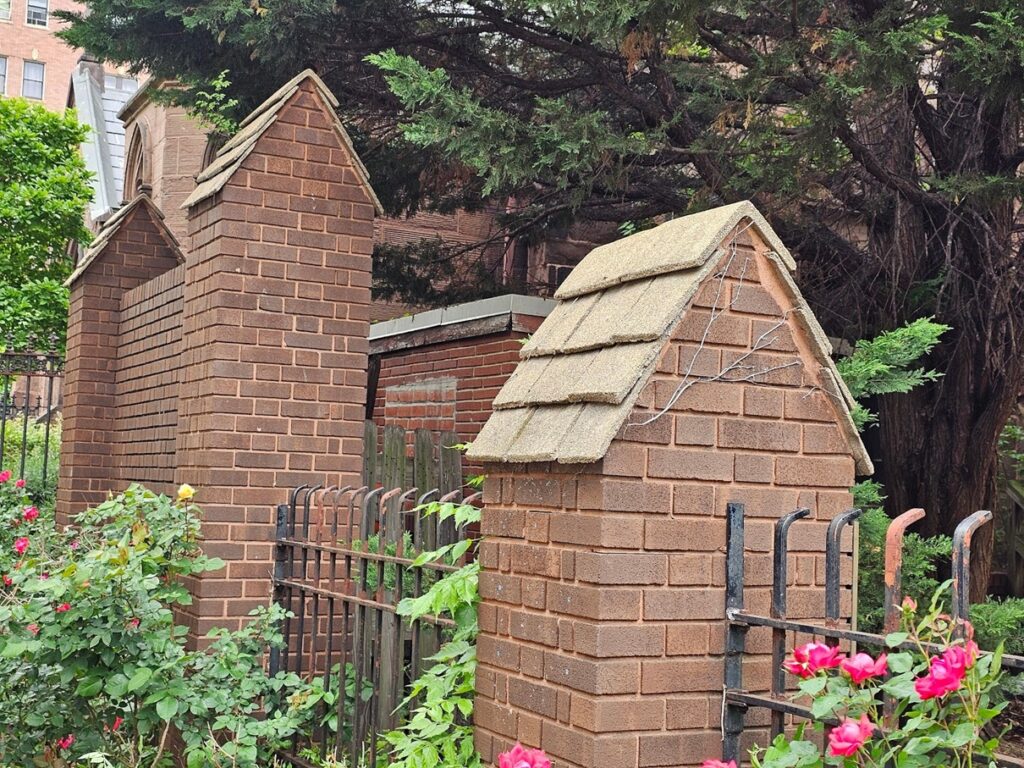
In modern times, we have site mobile 14-inch cutting discs that have segmented cubic zirconium teeth that can cut right through bricks. But even with a 14-in blade, it can only go about 6 inches deep. Here, in this particular type of application where the columns are so thick, 6 in isn’t even close to being able to reach from the ridge of the center of the column cap out to the eave (edge).
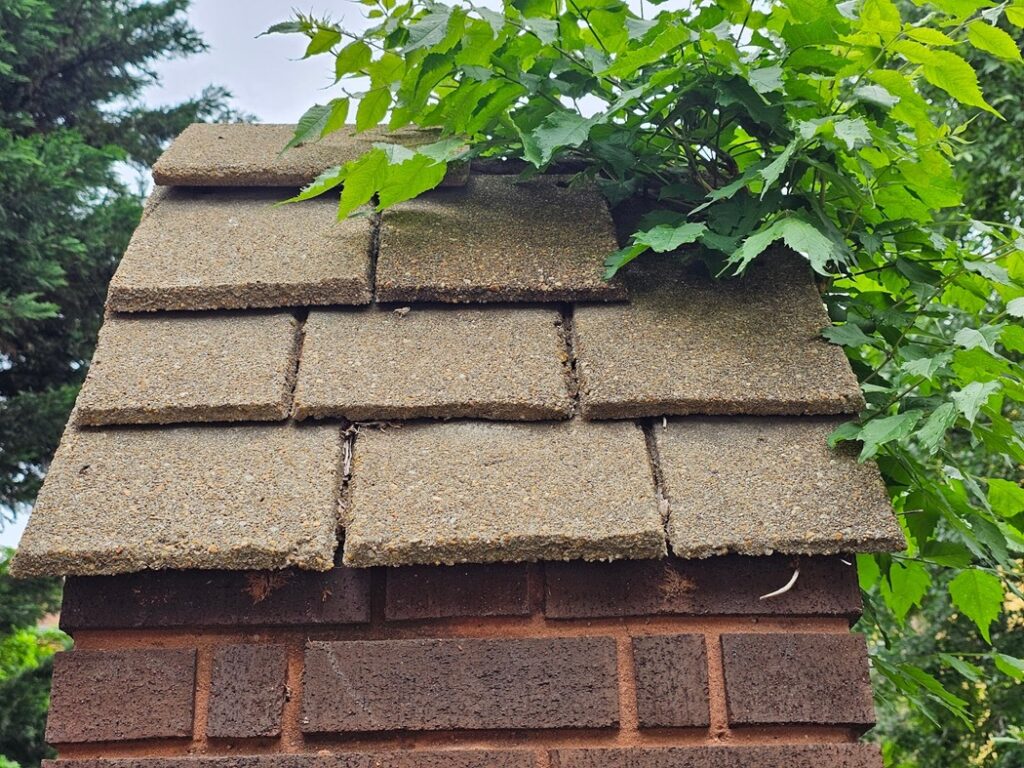
If you look at the individual pieces of this installation, other than the ridge itself, all of the other tiles, like real slate tile, are individual pieces. They’re not made from stone, though. They’re made from a type of concrete. Most concrete materials have relatively coarse aggregate. In this case, the aggregate is just a range of sand and very small stones. However, they are cast in a slurry and then set individually. As a side note, you may notice that the mortar joint at these bricks is a raked joint.
The raked joint was not very common here in Washington DC at the time of the original construction of the majority of the historic row homes. In fact, at that time, the flush joint was much more common, both for pressed brick and for the more prolific common brick.
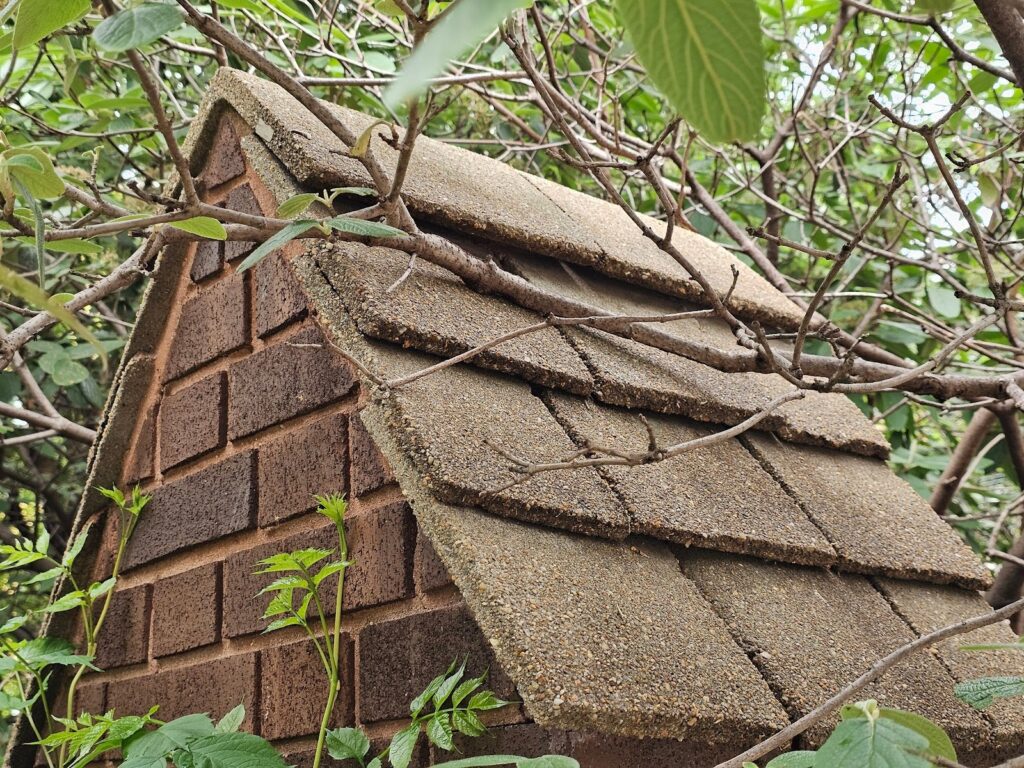
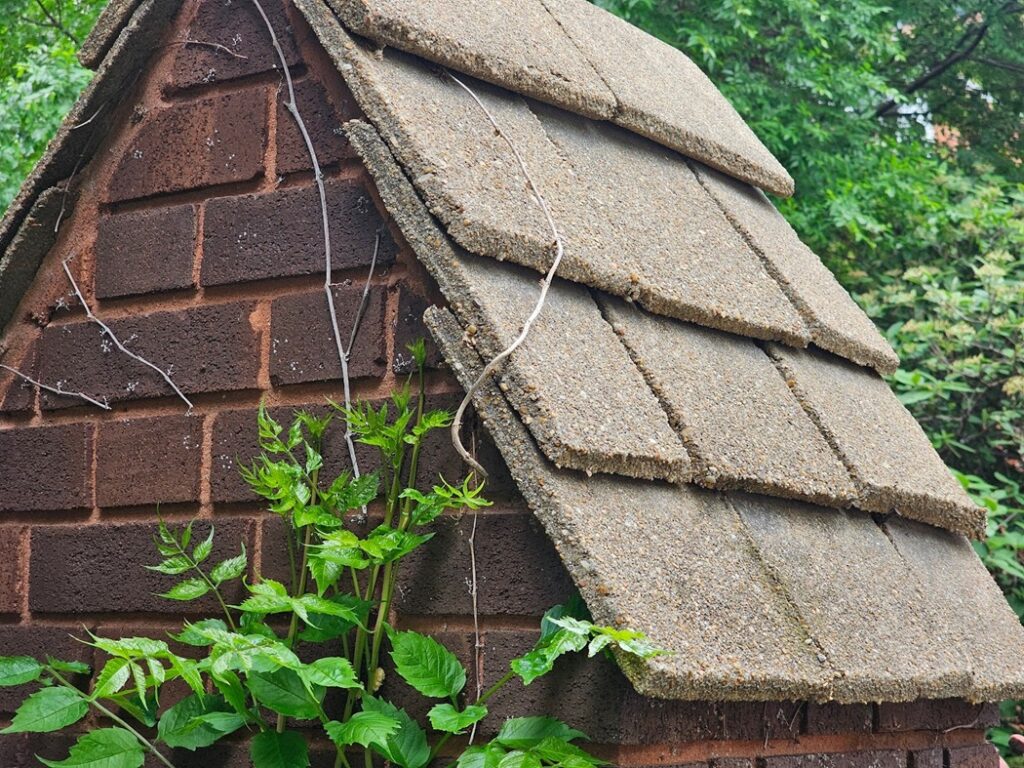
At a glance it actually may be easy to misunderstand the materials used here. Some people have thought that these were asphalt shingles, but they’re not in any way similar to asphalt shingles. They don’t have any bitumen materials and they have no fiberglass or fabric backing, they’re just individual pieces of cast in place concrete. Although they’ve held up well, you can see age at the surface. If you look more closely in the picture below, you can see a little bit of sand and aggregate exposed at the surface. The cementitious slurry had a colorant added that gave it this rose or reddish type color.
You may also notice that the mortar itself is more red than typical mortar. A typical historic mortar generally has a light tan type color. A typical contemporary or modern mortar has a light gray type color, generally. Here though, it’s different. The mortar has a color that’s a medium red. it wasn’t entirely uncommon for people to dye or tint mortar back in historic times, but it’s a bit unique. We can’t prove it for sure, but we would guess that the original concrete tiles and the original mortar had a very similar color but have simply faded differently over time.
One of the important things to take into consideration in repointing and tuckpointing type restoration is to try to use a mortar that respects the original color. However, we always prioritize physical characteristics over aesthetic characteristics when repointing. A poor job in the execution of combining the elements to a compatible physical characteristic can lead to accelerated deterioration of the brickwork. In simple terms, a building or even building wall can be destroyed by using the a mortar that is physically incompatible.
We can Help
Our company focuses on historic restoration more than modern building upkeep, maintenance, and construction, but our company understands both types of construction very well and a full picture well-rounded approach is needed in any niche in the construction industry. Although we focus on historic restoration, repointing, tuckpointing and historic brick repair, our company also has technical knowledge and competencies in the areas of modern and contemporary construction as well as we become one of the leaders in that area of the market today.
Understanding both historic and modern or contemporary construction is useful because both aspects help understand the challenges and potential solutions for challenges in building science and construction.
We can help with a variety of historic masonry restoration needs and upkeep, from modest tuckpointing and or repointing to complicated and extensive historic masonry restoration. Infinity Design Solutions is a historic restoration specialist contractor specializing in both historic masonry restoration such as tuckpointing our repointing, and brick repair. If you have questions about the architectural details or facade of your historic building in Washington DC, reach out and say hello and if we can help we’ll be glad to assist you. You can email us or call us on the telephone at the following link: contact us here.