
Understanding Buttressed Masonry Retaining Walls – Part I
There’s some principles of building construction that have improved and developed over time. There’s also some principles that go back for many decades, pretty deep into our history. Today, we’re looking at and really large historic retaining wall. This particular retaining wall is built with stone masonry. Historic brick masonry, as it applies to the majority of the historic buildings here in Washington DC, and historic stone masonry have some similarities. For the most part, similar mortar was used for setting historic common bricks and historic granite stone, in much of DC.
The restoration, upkeep and maintenance of these historic structures has similarities. Often, we look at the technical details related to historic masonry repointing. There are overlaps and similarities between the repointing required for historic brick restoration and historic stone restoration. One of the big problems in the technology of the time, around the 100+ years ago, was that hydrostatic pressure relief systems lacked impermeable fluid applied barriers, in historic times. The technology just didn’t exist yet. They didn’t have the use of sophisticated polymer type membranes, for example.
In most cases, today, the fluid apply type coatings work very well. Fluid applied coatings are different from the more traditional membrane type applications. They’re also different from the bitumen-based type roll-on applications.
In addition to the many chemical differences of the applications, the spray or roll-on type method of application also has some inherent differences. Particularly, with stone foundations and retaining walls, it’s much easier to follow a non-contiguous or nonlinear contour with a fluid applied system. For example, if you are applying a coating to the exterior of a barrel, it’s a relatively easy path to follow during application. By comparison, if you are painting a rough rock face of a cliff, it’s a very rough texture that the application tool will not conform to very well. That means that you must go back and touch up or fill in spots that were missed by the application tool.
Even though this sounds complicated, it’s much easier or a better methodology then trying to get a continuous roll-applied membrane to follow the same contour. It’s much more difficult with a membrane type application.
You can see a picture of one of the wide edges of this massive retaining wall. it’s not just here as shown in the picture, but beyond to the left and the right, the wall turns at a 90° angle and continues. This retaining wall is massive. This level of extra support, provided by the buttressed columns is necessary. In this case, the buttress columns are the triangle type supports that you can see spaced out, interspersed, along the wall.
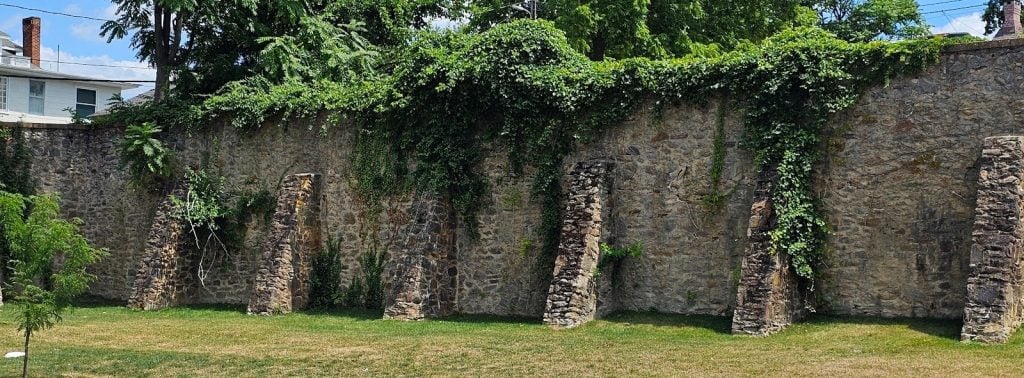
Those columns provide additional support for the wall. The wall itself has a relatively high intrinsic stabilizing force, but it’s not enough. The massive amount of earth being retained will apply a significant pressure or force against that wall. Therefore or therein, the wall must be able to resist that force. So far the wall appears to have survived for roughly 100 years. We think that’s a sign of structural success. Although covered, to an extent, with ivy, the overall condition of this wall is not bad. It’s been relatively well maintained and although some repointing would be helpful, it’s not in terrible shape. There’s no signs of current points of significant destabilization.
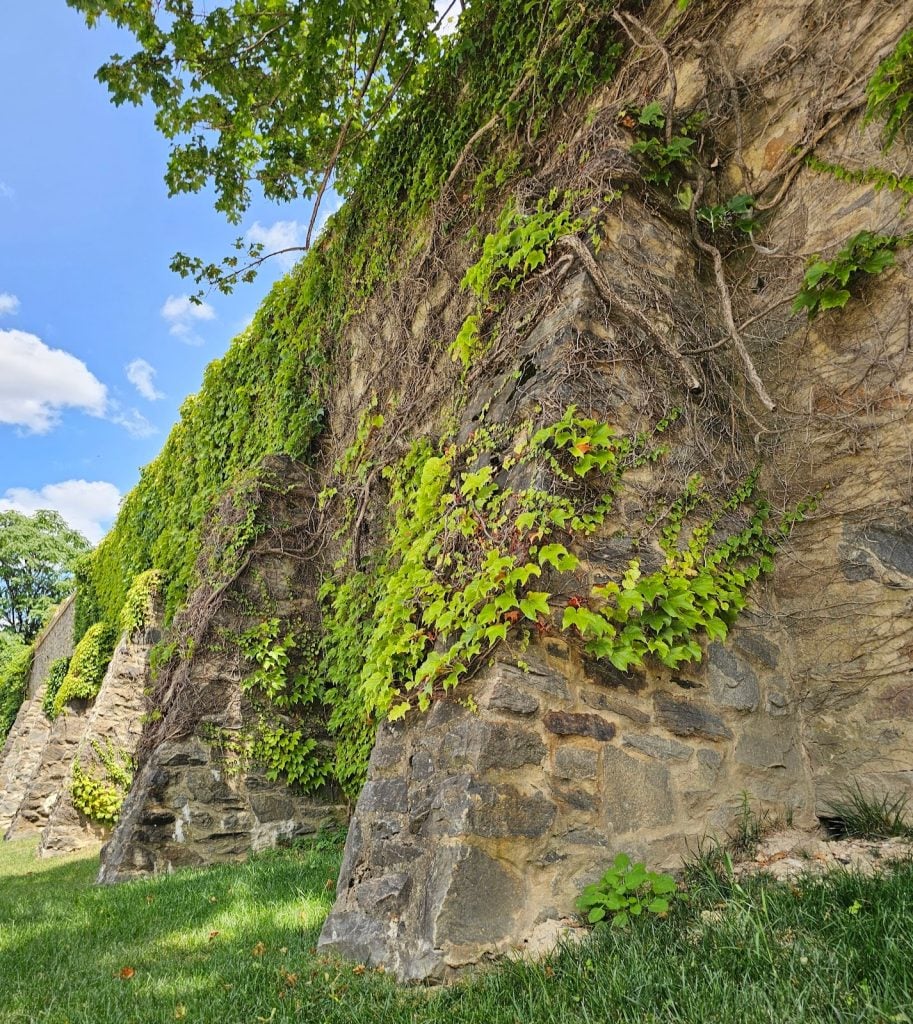
The angled shape of the buttressed support is not just for aesthetic considerations, it’s helpful from a structural perspective, as well. The load at the top of the wall is considered to be lesser than the load at the bottom of the wall. Not only is it cumulative, but mathematically, it’s at least partially exponential. The dirt itself presses against this wall, but that dirt has an angle of repose that’s intrinsic to the natural characteristic of the particular type of soil.
Generally the angle of repose for moderately clay soils, common in our area, is roughly 30°. That means that soil will stand up in piles, relatively high, but it will naturally fall in widen off of an edge at the angle of repose. You can think of it as the angle of which the soil will naturally reposition itself. For example, in the case of saying, that angle of repose is very high. If you pour a 13-inch tall bucket of sand onto the floor, it’ll spread out wide and low, instead of thin and high.
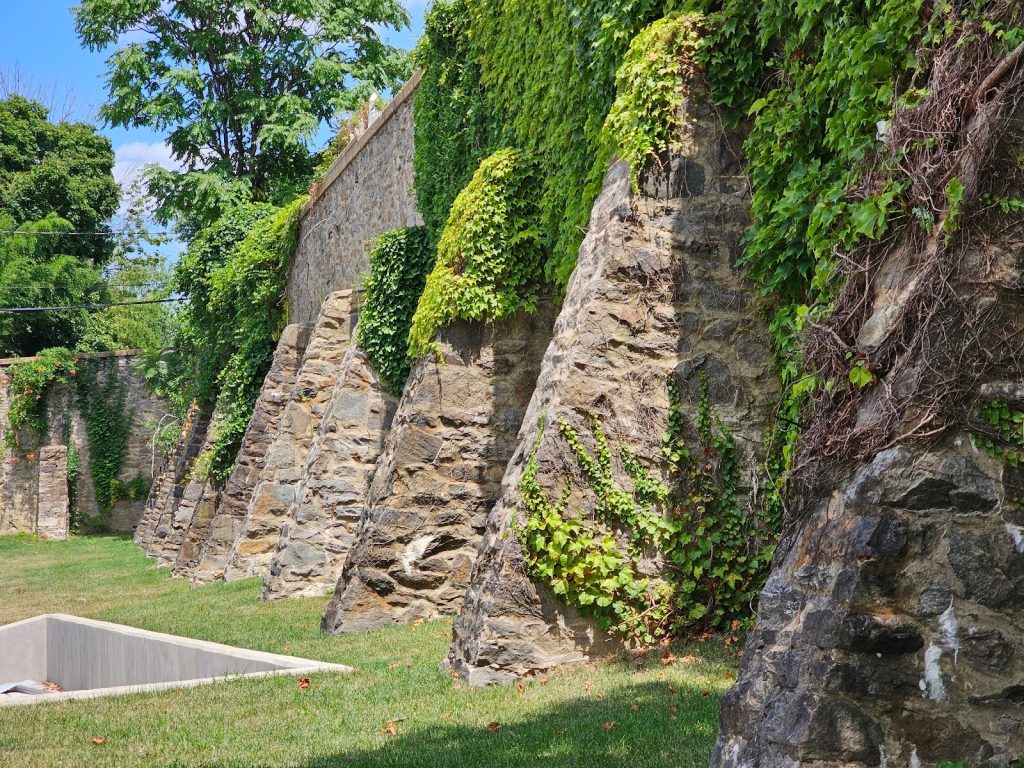
The issue of this retaining wall, larger than the issue of repositioning, is the concern of hydrostatic pressure build up. Essentially when that soil becomes wet, which it does when it rains, the water then presses against the wall. That water presses in a more horizontal or outward reaching type of nature. As it builds up though, the head pressure and build-up increases more at the lower area of the wall than at the higher area of the wall. For this reason, the triangular shape of the buttressed support makes sense.
From a functional perspective, it would be wasting materials, unnecessarily, to not build in a triangular type shape. You can see buttressed supports are built like this, throughout the world, going back hundreds of years. It’s not just a coincidence, there’s a purposeful reason behind the repeated methodology.
We can Help
Our company focuses on historic restoration more than modern building upkeep, maintenance, and construction, but our company understands both types of construction very well and a full picture well-rounded approach is needed in any niche in the construction industry. Although we focus on historic restoration, repointing, tuckpointing and historic brick repair, our company also has technical knowledge and competencies in the areas of modern and contemporary construction as well as we become one of the leaders in that area of the market today. Understanding both historic and modern or contemporary construction is useful because both aspects help understand the challenges and potential solutions for challenges in building science and construction.
We can help with a variety of historic masonry restoration needs and upkeep, from modest tuckpointing and or repointing to complicated and extensive historic masonry restoration. Infinity Design Solutions is a historic restoration specialist in Washington DC contractor specializing in both historic masonry restoration such as tuckpointing our repointing, and brick repair. If you have questions about the architectural details or facade of your historic building in Washington DC, reach out and say hello and if we can help we’ll be glad to assist you. You can email us or call us on the telephone at the following link: contact us here.