
Buttressed Masonry Retaining Wall Design – Part II
This past week, we began looking at this very large and impressive historic stone masonry retaining wall. It’s a simply beautiful construction. We happen to love the timeless beauty of historic masonry. In this case, this particular wall was built with a granite stone and a beige color mortar. Like many of the historic mortar around in the row home construction of Washington DC, this mortar also now is at the point where it needs upkeep and repointing. Repointing, for stone work, is similar but a little bit different than historic brick masonry repointing and restoration.
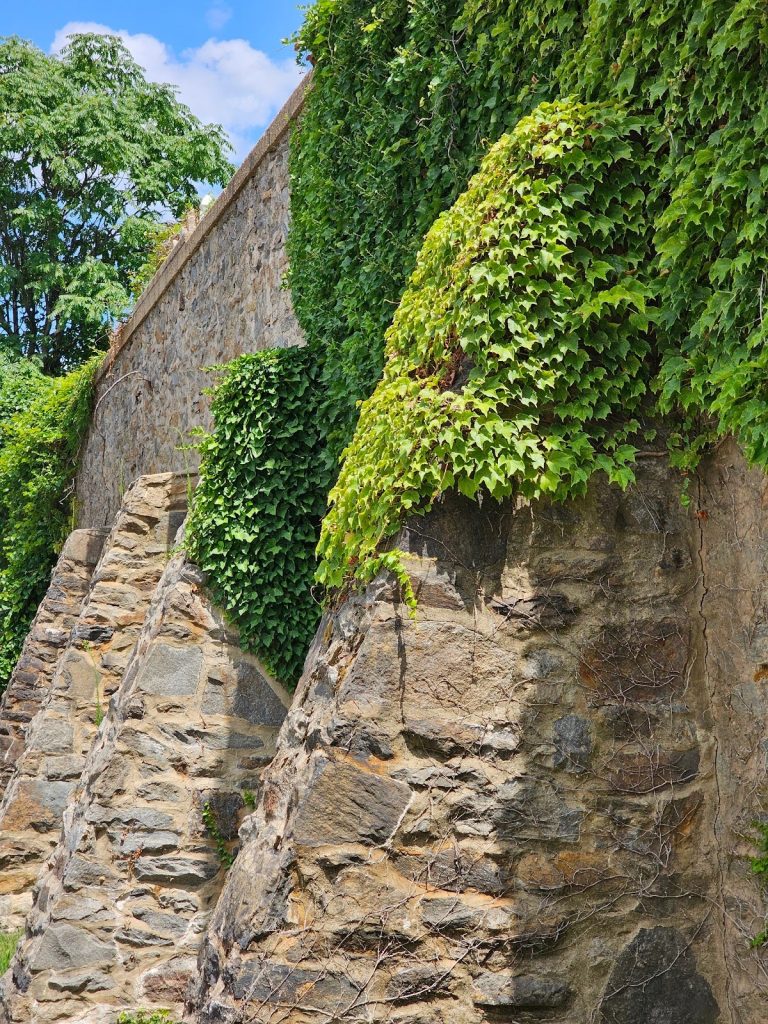
This past week we talked about the large buttressed supports, shaped like triangles. A close view of one of these supports is shown in the photo below.

If you consider the amount of deterioration that happens at a true vertical masonry surface, we could consider that a baseline. The amount and or timeline for deterioration and need restoration increases significantly when the angle of a masonry facing becomes increasingly angled towards horizontal. In this case, the buttressed support is at roughly a 60° angle. That means it’s not quite a 45° angle, nor is it a flat surface, yet it has more flatness than a vertical wall. Because of that angled flatness, water, in every incident of precipitation, will sit onto all of the horizontal little ledges.
Unlike a perfectly straight line, this wall is built in tons of little segments, each that step out farther than the next one below. Those little segments create small ledges. As that water lands and sits on top of those small ledge areas, it will dry and or be absorbed slowly into the masonry. After being absorbed, it causes dissolution and a variety of types of deterioration of the masonry and the mortar.
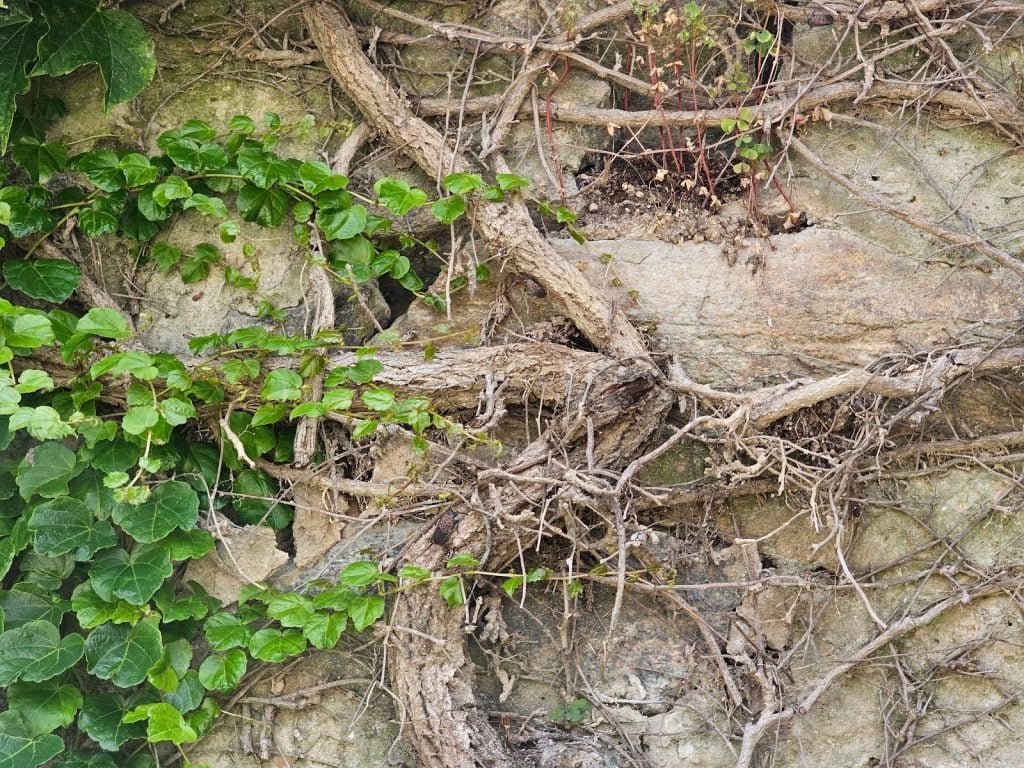
We like the way the vines look on the face of this historic stone masonry, but the vines don’t help the masonry. In fact, they can lead to increased retention of moisture. Increased retention leads to increased cycles or durations of time of hydration. Essentially covering the wall with an ivy like this keeps the wall wetter after each cycle of precipitation which leads to a higher rate of deterioration. There’s also an additional issue or concern with ivy growing on a brick wall. As roots grow across the wall, they also look to grow into small crevices and voids.
Once those roots take position in those voids and small cracks or crevices, they grow and expand. Even though some plants may be relatively weak, plant root systems can be extremely tough. As they grow between hard materials, they can literally break those materials apart.
The picture below shows the web of roots from the ivy growing on this wall. This particular type of ivy is a Boston Ivy. It’s very similar to other common types of ivy varieties here in our DC area. We would say there’re three main types of ivies that we commonly see growing on historic masonry structures. One of the most common ones, here in DC, is English Ivy. Another very common type of ivy is called Virginia Creeper. Boston Ivy is one of the third most common types of ivies that grow commonly on historic masonry buildings in DC.
A really interesting facet about Boston Ivy though is that, like Virginia creeper, Boston Ivy is not an actual ivy. It’s textually part of the family of grapevines, from a botany perspective. Also, like Virginia creeper, Boston ivy doesn’t have a root system that penetrates as deeply as English Ivy. For this reason, both Virginia Creeper and Boston Ivy are known to cause less damage to masonry surfaces than English Ivy.
Some of these buttressed elements or areas above the coping at the top of the wall have decorative finials. Essentially, like little chimneys, the stone work is built up to replicate a cranulet type of layout. Similar to chimneys, these particular elements, since they stand up as thin structures on their own, are hit with more of the concerning deterioration type of pressures from weather.
Exterior historic masonry walls also face these pressures. However, in the case of these thin piers that stand up high on their own, they’re constantly hit on all sides. They’re hit by a higher degree of precipitation, and they don’t have much of the ability to rely on the greater continuity of a wall to provide support through continuity.

We can Help
Our company focuses on historic restoration more than modern building upkeep, maintenance, and construction, but our company understands both types of construction very well and a full picture well-rounded approach is needed in any niche in the construction industry. Although we focus on historic restoration, repointing, tuckpointing and historic brick repair, our company also has technical knowledge and competencies in the areas of modern and contemporary construction as well as we become one of the leaders in that area of the market today. Understanding both historic and modern or contemporary construction is useful because both aspects help understand the challenges and potential solutions for challenges in building science and construction.
We can help with a variety of historic masonry restoration needs and upkeep, from modest tuckpointing and or repointing to complicated and extensive historic masonry restoration. Infinity Design Solutions is a historic restoration specialist contractor specializing in both historic masonry restoration such as tuckpointing our repointing, and brick repair. If you have questions about the architectural details or facade of your historic building in Washington DC, reach out and say hello and if we can help we’ll be glad to assist you. You can email us or call us on the telephone at the following link: contact us here.