
Cliffbrakes Growing in Historic Mortar Joints: Part II
This past week we took a look at this particular masonry wall with Cliffbrakes, a type of fern plant, growing out of the brick joints. The mortar is so deteriorated and needs repointing so badly that plants have just started taking root inside of the mortar. We explained that as the roots grow into that deteriorated and soft, sandy mortar, they break down the remaining mortar and increase the acceleration of deterioration. It’s an overall bad cycle, a vicious cycle.
Repointing involves removing the soft and deteriorated mortar at the exterior face of the brick. Generally the depth of that deterioration only goes in, up to about an inch, from the face of the brick. Once the old and deteriorated mortar is removed, the remaining substrate is hydrated and replaced through the repointing process.
The repointing process generally applies a lime mortar into historic brickwork. That mortar is applied in successive lifts until it is basically flush with the exterior face of the brick. There are multiple different types of striking profiles. A striking profile is the form applied to the exterior face of the mortar. This is a typical part of the repointing process. In modern brick work, the joints are generally tooled with a concave or bucket handle type of profile. In historic times, particularly as accurate to historic brickwork in Washington DC, the tooling will generally be done in a flush facing.
We looked at one picture, this past week, where somebody went and did a poor job of installing caulking into the recessed and deteriorated mortar joints. They shouldn’t have done that, it’s bad for the brick work. Essentially, caulking has a high degree of impermeability. Historic brickwork was fired at a low temperature. By firing the brickwork in historic kilns, and using organic materials for the heat source, the Kiln temperatures did not get as hot as modern kilns.
Therein historic bricks have less vitreousness. They also have a lower compressive strength. The lower degree of vitreousness means that the bricks have a higher porosity. Higher porosity isn’t necessarily bad, but it means that the historic bricks can absorb a bit more water than modern bricks. Once water is absorbed, if the mortar is compatible, the brick wall breathes evenly.
This issue of compatibility is one of the main reasons why it’s extremely important to use a professional contractor who is dedicated to repointing. It’s not hard to learn these techniques, but it does take time and practice our company, for example, has been doing this type of work, dedicated, for many years. We explain these things here, to help people learn and also to help people avoid working with a contractor who doesn’t understand these differences. We see these problems, too often. The photos below are examples. Here, the contractors who applied this caulking didn’t understand what they were doing.
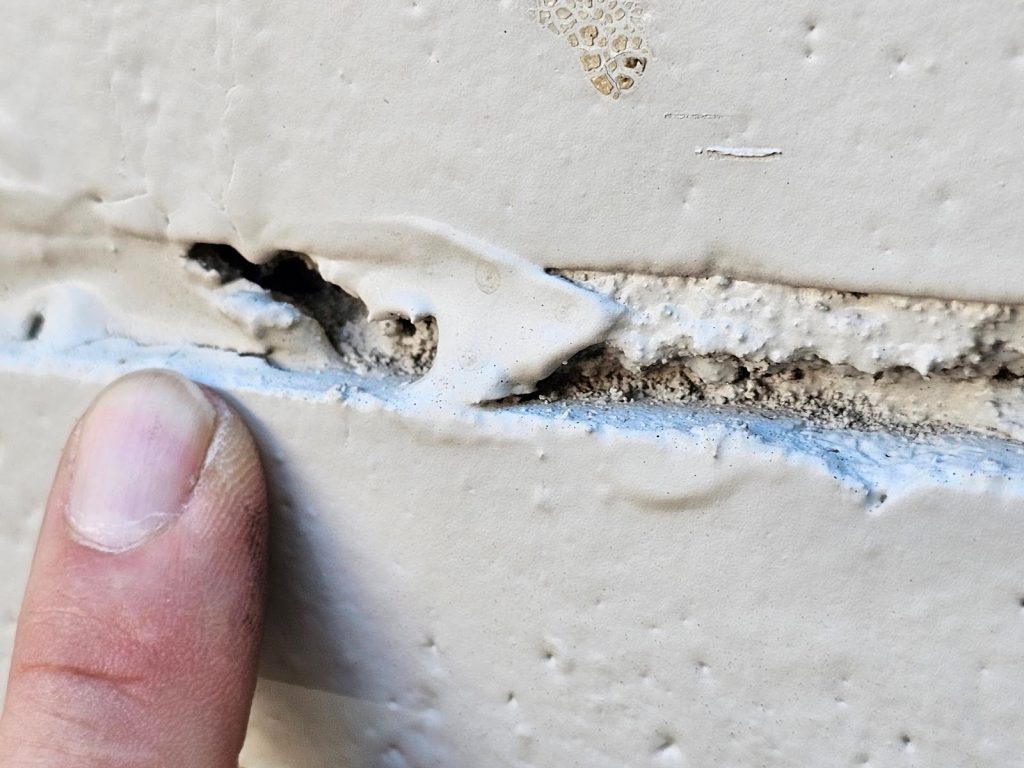
In the picture below it looks like the joint where I’m pointing has been repointed and then tooled with a concave striking. It hasn’t actually been repointed though. Instead, somebody just filled the joint up with caulking and smoothed out the surface. As this low permeability caulking fills the mortar joint, it prevents the escape of moisture. That leads to a buildup of moisture behind or on the inside of that caulking bead. As moisture and water builds up on the inside of that caulking bead, it leads to damage. During the warm months of the year, the damage takes place in slow dissolution and deterioration of the brickwork and the remaining mortar.
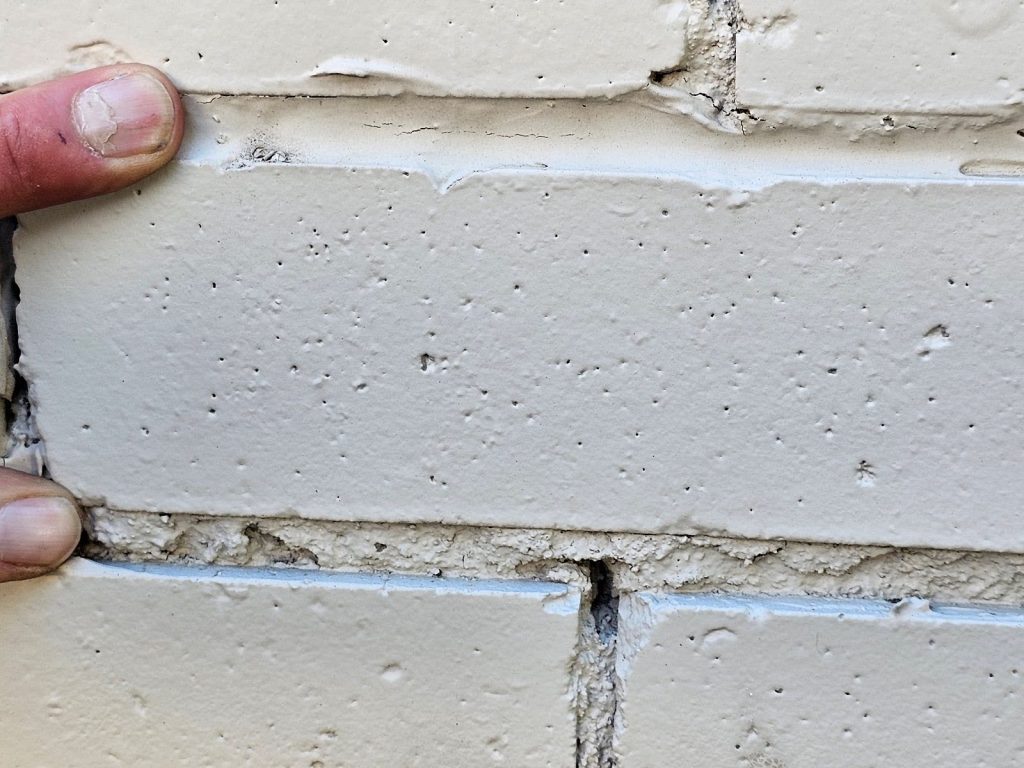
During the winter months, the problem is even worse. As that water builds up, when temperatures get low enough to freeze, especially problematic during successive freeze-thaw cycles, it leads to very high pressure on the brick. The brickwork is rigid enough that it will resist that pressure from the ice, but only to a point. Once that pressure reaches the compressive strength resistance limit of the brick, it will cause the brick to crack and break. Often, when bricks break at the surface, we will refer to that type of breakage as spalling.
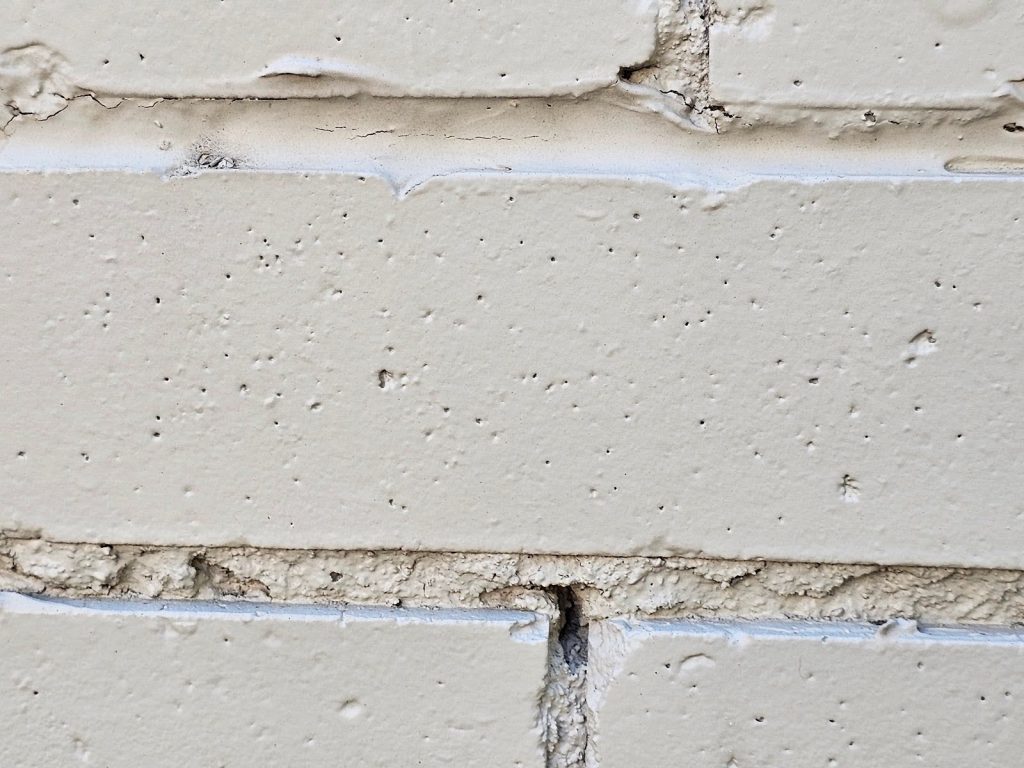
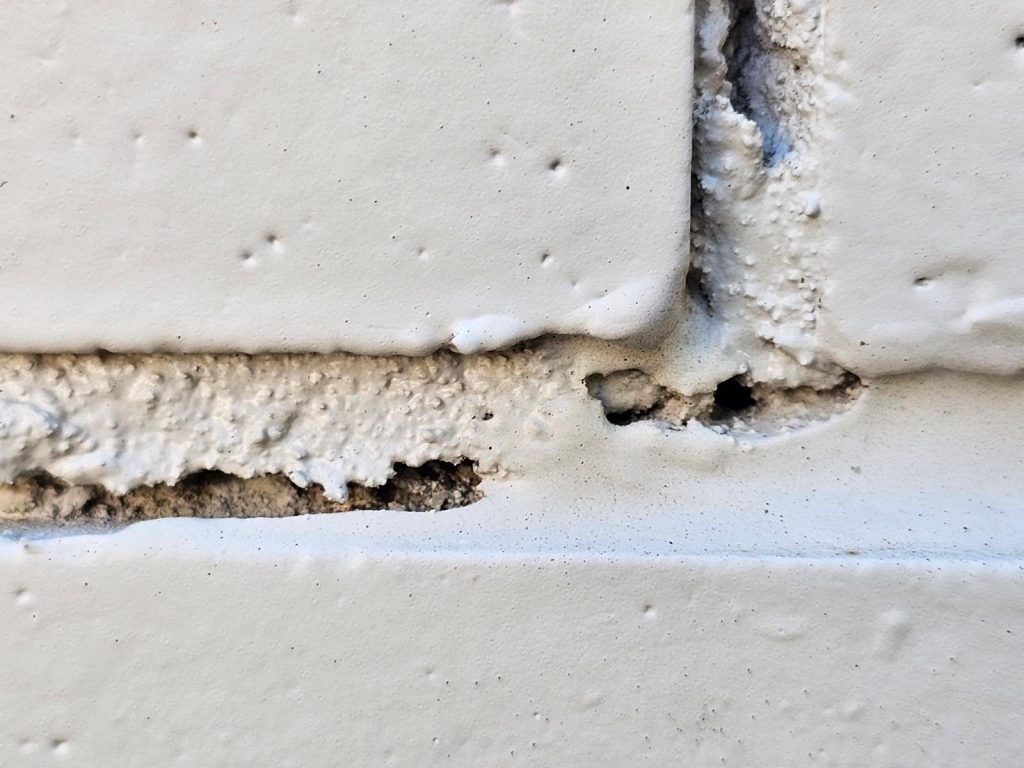
Looking at this, forensically, it looks like they started applying caulking, as a shortcut to avoid proper restoration, but they only did it at spots. It’s like they wanted to make it a little bit better looking and hide the real problem but they weren’t willing to apply enough caulking to hide it completely. It’s likely this was done by the painter. We aren’t blaming painters just because they are painters, but some signs indicate this caulking application may have been done right before the paint was applied.
Some buildings were painted many generations ago and then repainted many times. This particular building though has a texture that telegraphs very clearly through the paint. That’s a sign that there’s very few coats of paint on this brick. Also, when applications of paint were applied decades ago, you have incidences of paint delamination. Here, this deteriorated mortar which was likely original to the building, has a texture that translates very clearly through the thin paint and there are no signs of delaminating paint.
That means that it’s likely this paint was applied not that long ago. It’s also likely that this building facade was not previously painted. Considering all these elements and conditions together, it makes it more likely that the painter applied this caulking, just to cover up the worst spots. They shouldn’t have done it, but they may not have known any better. We recommend that if a building’s never been painted before, and you want to paint it for the first time, and it’s a historic masonry building, you should talk to a contractor like us first. By having a contractor like us provide a bit of analysis, we can recommend better solutions.
Repointing is a lot more expensive, but it has a highly positive ROI because it can preserve a building of this type for many decades to come. By sweeping these problems under the rug, it’s ineffective. The attempt at hiding the mortar damage isn’t working. You can still see that damage very clearly. It also hurts from a functional perspective.
We can Help
Our company focuses on historic restoration more than modern building upkeep, maintenance, and construction, but our company understands both types of construction very well and a full picture well-rounded approach is needed in any niche in the construction industry. Although we focus on historic restoration, repointing, tuckpointing and historic brick repair, our company also has technical knowledge and competencies in the areas of modern and contemporary construction as well as we become one of the leaders in that area of the market today. Understanding both historic and modern or contemporary construction is useful because both aspects help understand the challenges and potential solutions for challenges in building science and construction.
We can help with a variety of historic masonry restoration needs and upkeep, from modest tuckpointing and or repointing to complicated and extensive historic masonry restoration. Infinity Design Solutions is a historic restoration contractor in Washington DC specializing in both historic masonry restoration such as tuckpointing our repointing, and brick repair. If you have questions about the architectural details or facade of your historic building in Washington DC, reach out and say hello and if we can help we’ll be glad to assist you. You can email us or call us on the telephone at the following link: contact us here.