
Deteriorating Paint Effects on Masonry
We look at deteriorating mortar and deteriorating masonry, often, here on our website. It’s one of the main dedications and our principle purposes as a company. We specifically specialize in historic restoration of masonry facades. But even though this topic seems to be one that we talk about a lot, today we’re looking at a different angle, a different issue. We’re looking at masonry that’s deteriorated underneath a paint, applied to the surface of the wall. We aren’t necessarily saying that the deterioration was caused by the paint, but there are some possible areas where these things are related. We’re going to examine these details today.
The historic side facade, shown in the picture below is a long and expansive side, along an alley, here in Washington, DC. Buildings like this are somewhat common here, this one happens to be longer than the typical though.
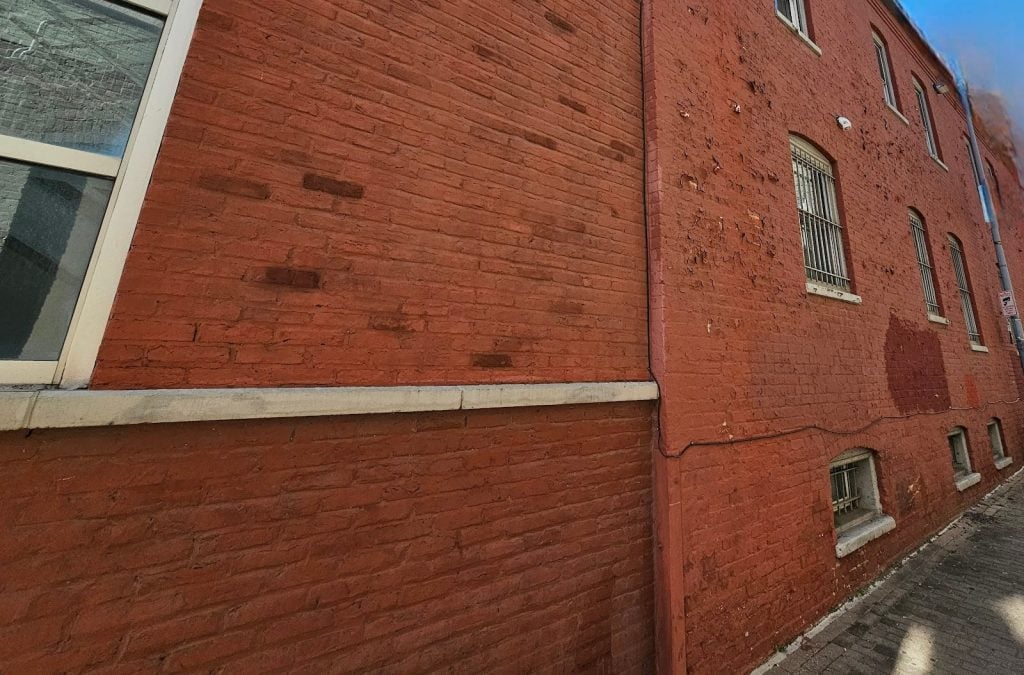
In the picture below, you can see how the paint is just flaking away. Before even touching it you can run your fingernails over it and tell there’s a sound of delamination. Often when materials are delaminated from their substrate, they still stay in place for a bit because they’re held on by where they’re attached at the sides of the remaining parts of the applied surface.
When you touch them, even gently, with something relatively hard like a brush or even a fingernail, they make a dull sound. You can hear that dull sound. It’s similar to hammer sounding on a stucco wall. When you tap on a piece of stucco, where it is delaminated, instead of making a sharp ring, it makes a dull and low-pitched sound.
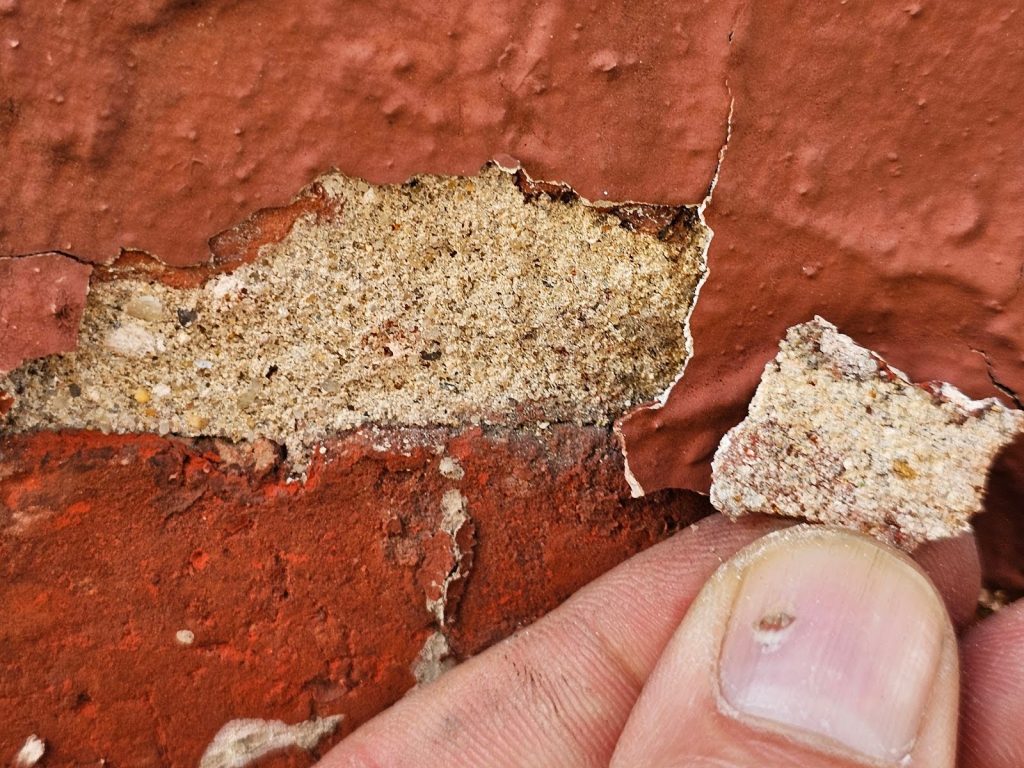
When you look at the surface of the wall at a relatively low angle, at an oblique angle, close to the surface, you can see that the paint is separated. Even the pieces that remain intact, particularly where coincident with the joint of the masonry, have a separation.
Where you see the dark shadow at the edge of the paint, that indicates separation. Where there is separation, particularly where there’s hairline cracks in the paint, there will be water infiltration. Particularly at these spots, hydration and moisture will build up. At times of freeze-thawing, it can lead to expansive conditions which can damage or crack the mortar or masonry. At other times it will lead to overhydration which accelerates deterioration and causes substrate material loss through efflorescence.
In general, moisture infiltration leads to deterioration and eventual destruction of masonry buildings. Masonry, in general, is also made to resist moisture, but particularly where moisture is trapped against masonry, those areas can be problematic. This is one of those examples. As the moisture infiltrates into the joints, particularly where they already have experienced some level deterioration, they enter farther and that cycle repeats. Again and again, that becomes a vicious cycle.
Eventually breaking down the mortar and leading to even the structure of the brick itself. The mortar is intended to be sacrificial. That means that the mortar is basically intended to be repointed over time. This was a known reality or condition, even way back at the initial construction of these buildings, over 100 years ago. People understood that the mortar joints would be repointed in the future and they also understood that those mortar joints would be much less expensive to restore than broken bricks.
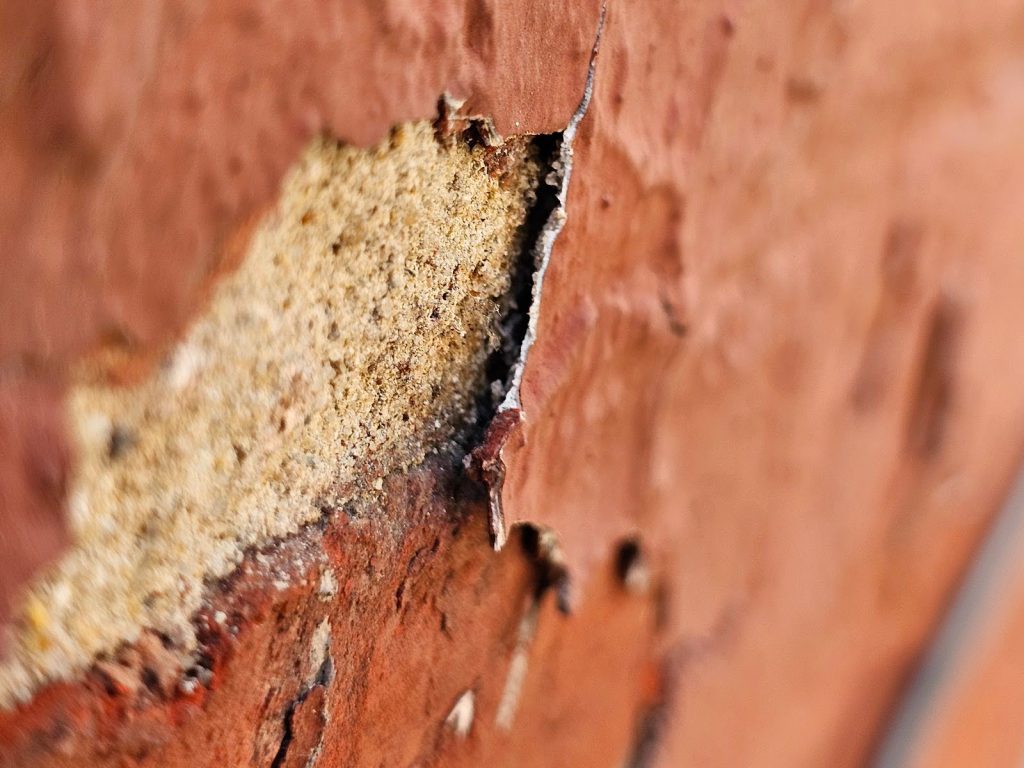
Here, though, this deteriorating mortar has also led to destruction of the bricks. Over time, with ingress of moisture, mortar deterioration, can lead to damage and destruction of the bricks themselves. One of the most common ways this happens is by spalling. Spalling is the breakage of the exterior face of masonry units such as bricks or even other types like stones, and then the flaking off or falling off of the masonry face. This generally happens unit by unit, brick by brick.

We can Help
Our company focuses on historic restoration more than modern building upkeep, maintenance, and construction, but our company understands both types of construction very well and a full picture well-rounded approach is needed in any niche in the construction industry. Although we focus on historic restoration, repointing, tuckpointing and historic brick repair, our company also has technical knowledge and competencies in the areas of modern and contemporary construction as well as we become one of the leaders in that area of the market today. Understanding both historic and modern or contemporary construction is useful because both aspects help understand the challenges and potential solutions for challenges in building science and construction.
We can help with a variety of historic masonry restoration needs and upkeep, from modest tuckpointing and or repointing to complicated and extensive historic masonry restoration. Infinity Design Solutions is a historic restoration specialist contractor specializing in both historic masonry restoration such as tuckpointing our repointing, and brick repair. If you have questions about the architectural details or facade of your historic building in Washington DC, reach out and say hello and if we can help we’ll be glad to assist you. You can email us or call us on the telephone at the following link: contact us here.