
Fire Damage to a Historic Building: Structural Impacts and Restoration Insights
This past week, we were talking about some of the risks of fire jumping from one building to the next. We talked about how even though a lot of the historic architecture and construction was pretty insightful and well executed, it wasn’t always perfect. The attics are a particular place where shortcuts were often taken in the masonry construction. Even though the brick has an intrinsic fire resistance, the original brick masons, in the demising walls in the attics, for example, might leave an easy passageway for a fire to jump from one building to the next. Here, today, we’re going to describe some of these deficiencies in greater detail.
Builders would often leave pockets to set the roof rafter and ceiling joist ends. Essentially, recesses of about three and a half inches deep are often left in these bricks so that it can be a little pocket for beams or joists or rafters to sit inside of. The end of those rafters and beams were normally cut with a slight angle so that if they were to collapse, from a disaster, like of fire, the downward tilting movement of the joist or rafter or beam wouldn’t necessarily cause a seesaw type action to destabilize the brick above the pocket.
This angled cut is referred to as a fire-cut. Not many people outside of the historic restoration specialty type businesses are familiar with the terminology and the functional purpose. It was smart, even 100 years ago, builders and architects knew how to do some things right. They also cut some corners though. Sometimes in the demising walls that separate one attic from the next we’ll find large openings that let things like the fumes from cooking or cigarette smoke from one unit migrate into the attic of the next building.
People in the next building can often smell these fumes even though they don’t understand how it would be passing from one building to the next. The same types of passageways are often channels that allow fire to jump from one building to the next as well.
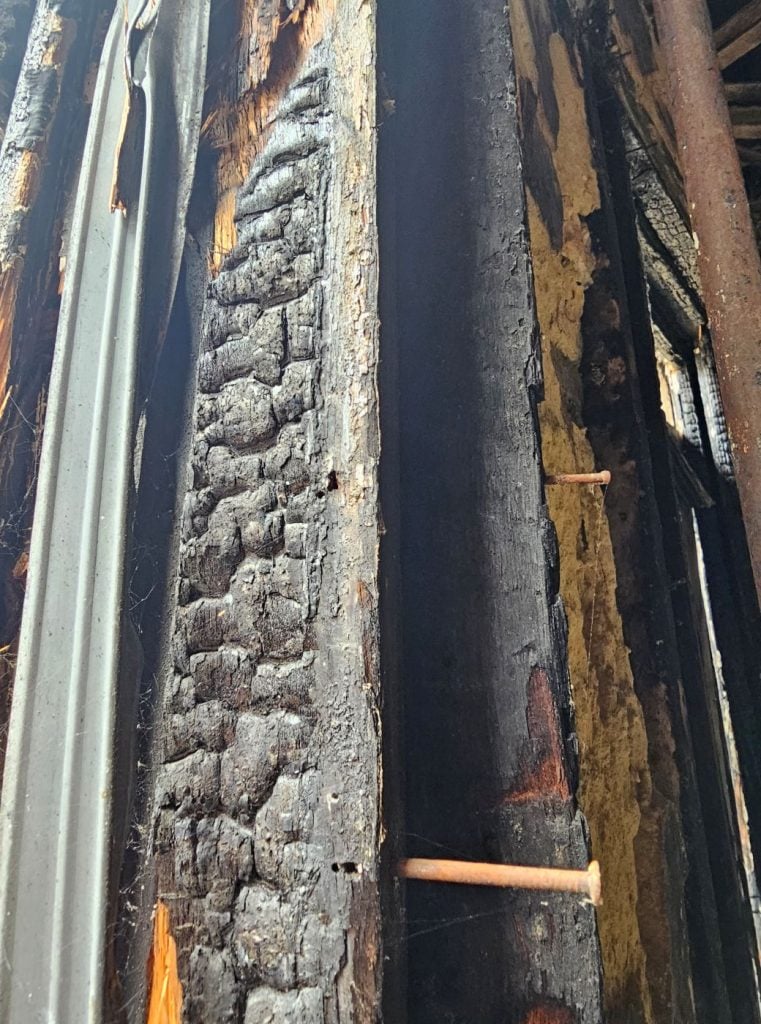
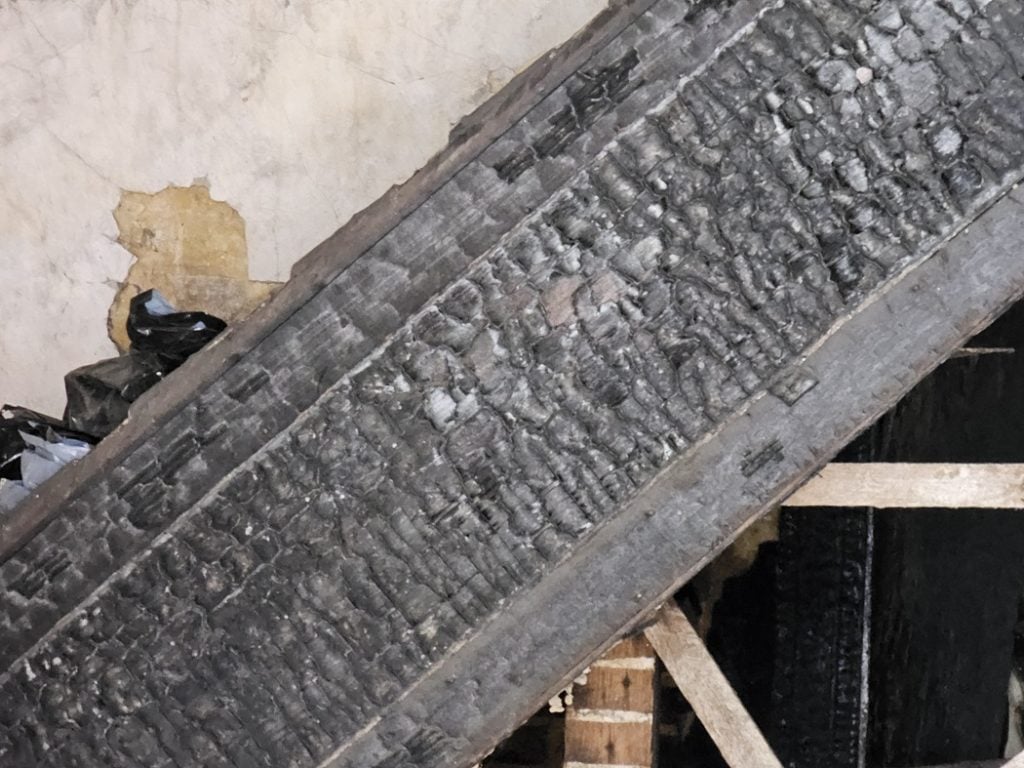
In the pictures above and below, you can see that some of the trim boards and even the very thin wood lathe at the ceiling framing still remains. It’s damaged by the fire, but it isn’t burnt so badly that there are no remnants left. The wood lathe was installed on top of the wall framing and underneath the ceiling joists. It was used so that it could be a backer for the application of plaster. Plaster is essentially applied like smearing peanut butter onto a piece of bread. Of course we are oversimplifying it drastically, but in a simple sense, this analogy is somewhat accurate.
When these historic homes were built about 120 years ago, wallboard like gypsum sheetrock didn’t exist yet. Instead, they would just put the plaster directly on top of the brick wall surfaces. At framed areas, where there were wood studs or joists, there would be large open spaces. So you couldn’t apply plaster directly to an open space. To provide a backer for the plaster, these thin wood slices, called wood lathe, were laid over top of the joists and studs.
They would be nailed on with a thin space of roughly a quarter inch between each strip. They were installed perpendicular to the run of the joist or the studs. Then, plaster could be smeared right on top of the face of the wooden lath. In a quick and rough kind of sense, that’s how historic walls were built using wood.
There are of course other examples of completely wooden buildings like log cabins and homes built with lap siding. Those types of buildings are sometimes seen, even here in Washington DC, but they are rare. Wood was somewhat limited in a dense area and people knew there was a fire risk, even 120 years ago. People also knew brick buildings were better for resisting moisture. Really, brick buildings are better in many ways.
They provide a better thermal barrier, even though brick masonry doesn’t have a high thermal resistance, it’s a solid mass that is more significant than thin strips of wood. It doesn’t have the same amount of joints that are basically open between pieces of lap siding all across a framed wall. So even though a brick can get down to freezing cold temperatures in the winter and then hold and emit that coldness back out, it’s still sealed up better. That even takes into account the typical type of holes you might find in brick mortar.
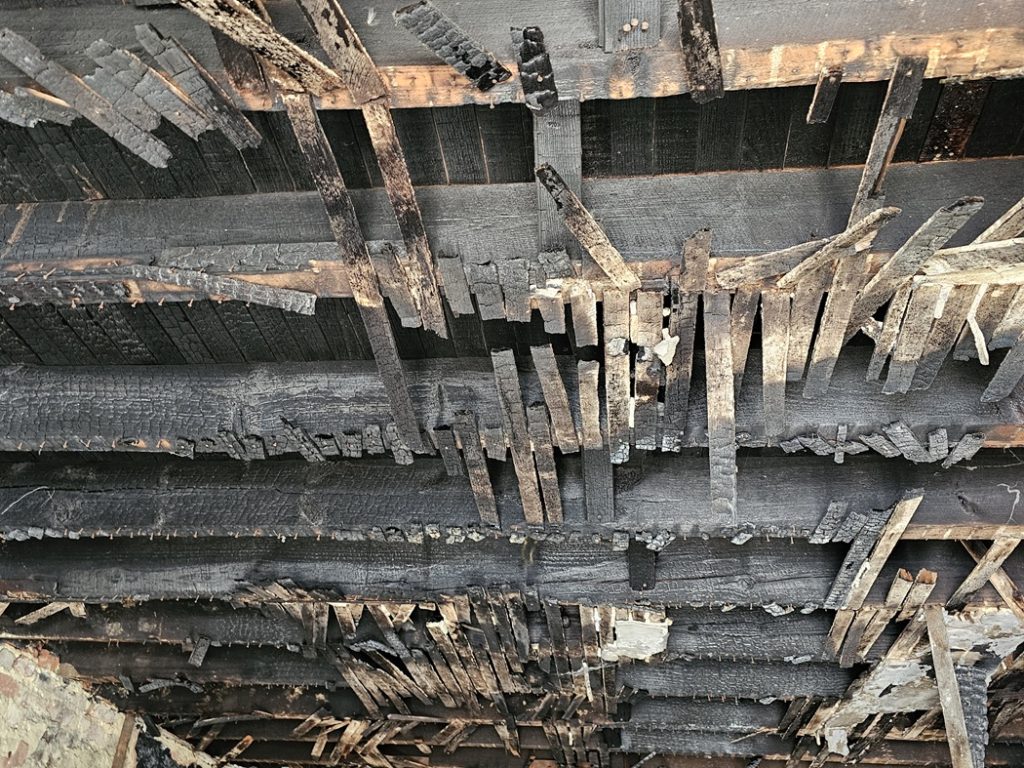
Even though this building caught fire and was basically ruined, it didn’t spread the fire onto other buildings, nor did it erupt in such drastic flames that it all burned down instantly. In fact, it looks like the fire was put out by the fire trucks in their hoses before it burned down all of the framing. The sad reality though is that the water pumped in by the fire department probably ruined any chance of easy renovation of the building.
We can Help
Our company focuses on historic restoration more than modern building upkeep, maintenance, and construction, but our company understands both types of construction very well and a full picture well-rounded approach is needed in any niche in the construction industry. Although we focus on historic restoration, repointing, tuckpointing and historic brick repair, our company also has technical knowledge and competencies in the areas of modern and contemporary construction as well as we become one of the leaders in that area of the market today. Understanding both historic and modern or contemporary construction is useful because both aspects help understand the challenges and potential solutions for challenges in building science and construction.
We can help with a variety of historic masonry restoration needs and upkeep, from modest tuckpointing and or repointing to complicated and extensive historic masonry restoration. Infinity Design Solutions is a historic restoration specialist contractor specializing in both historic masonry restoration such as tuckpointing our repointing, and brick repair. If you have questions about the architectural details or facade of your historic building in Washington DC, reach out and say hello and if we can help we’ll be glad to assist you. You can email us or call us on the telephone at the following link: contact us here.