
Why Brick Wall Tops Are Prone to Mortar Damage
This past week, we finished the two part series looking at ferns growing into mortar joints. Someone had smeared caulking onto the recessed and deteriorated mortar joints. We think they did this just as a cover-up to try to make it look a little better, but it’s bad for the brickwork. (Be careful if you are buying a house flip. You can hire us for circumstances like that just to do a condition survey of a masonry facade.) They didn’t even cover the mortar joints completely. It was really bad work done as part of what we think was a cover-up.
From a functional perspective, this type of problem, and half-way attempt at a solution, still lets water enter into the mortar joints and continue causing damage. Particularly where there’s a crevice or recess in the mortar joints, when they hydrate or become wet, there’s a place for water to build up like it’s sitting on a ledge. Just like the water now being built up behind the caulking, where it builds up on a ledge, it will increase the breakage and damage of the adjacent materials.
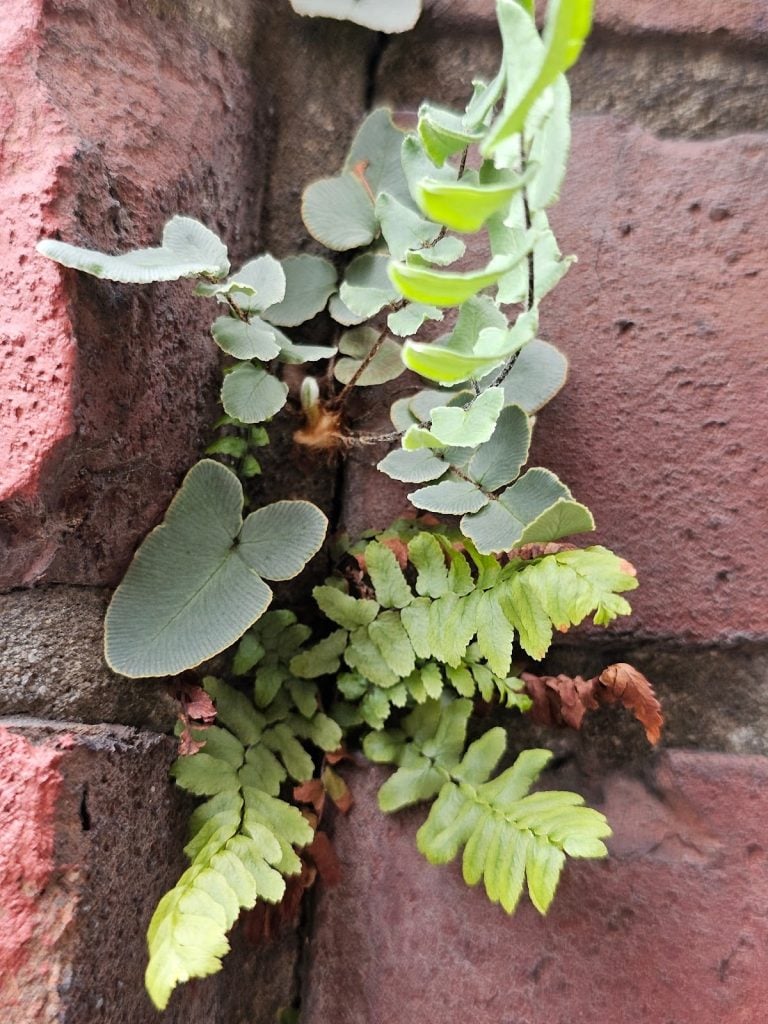
As we looked at the fern plants growing into the mortar joints of the painted building we talked about how that water buildup will cause damage to the bricks. It’s a vicious cycle. Today we’re also showing more pictures, like the one below, where Cliffbrake ferns are growing into the deteriorated mortar joints of a different unpainted building. Here, you can see the exposed original faces of the brickwork.
The next picture below shows the top of the unpainted brick wall. Here as well, other plants are growing into the recessed and deteriorated mortar joints. The top of walls are particularly susceptible to damage. Because these wall tops are in a horizontal position, water builds up more and causes the top of the wall to erode away and seep deeper and dry slower. The horizontal area provides a larger ledge area. As the mortar begins to deteriorate at the top of the wall it also creates a vicious cycle. The deterioration leads to deeper recesses which essentially create a ponding or pudling area where water will continue to build up at every iteration of rainfall.
At almost every single example of brick walls above rooftops, the brick walls, whether it be a parapet or any other type of wall, are generally covered with a coping. Copings are low permeability coverings that prevent water infiltration into the top of the wall. At a wall like this, shown below, the wall needs to be either very well maintained through proactive repointing, or it needs to be covered with a coping stone or a coping metal. For architectural reasons, we would recommend a coping stone or masonry coping at lower areas where the wall tops are easily visible.
At rooftops where the parapet walls are completely hidden from everyday view, it’s totally fine to use a metal coping. The metal copings don’t even look particularly bad, they just don’t look in keeping with the historic architecture.
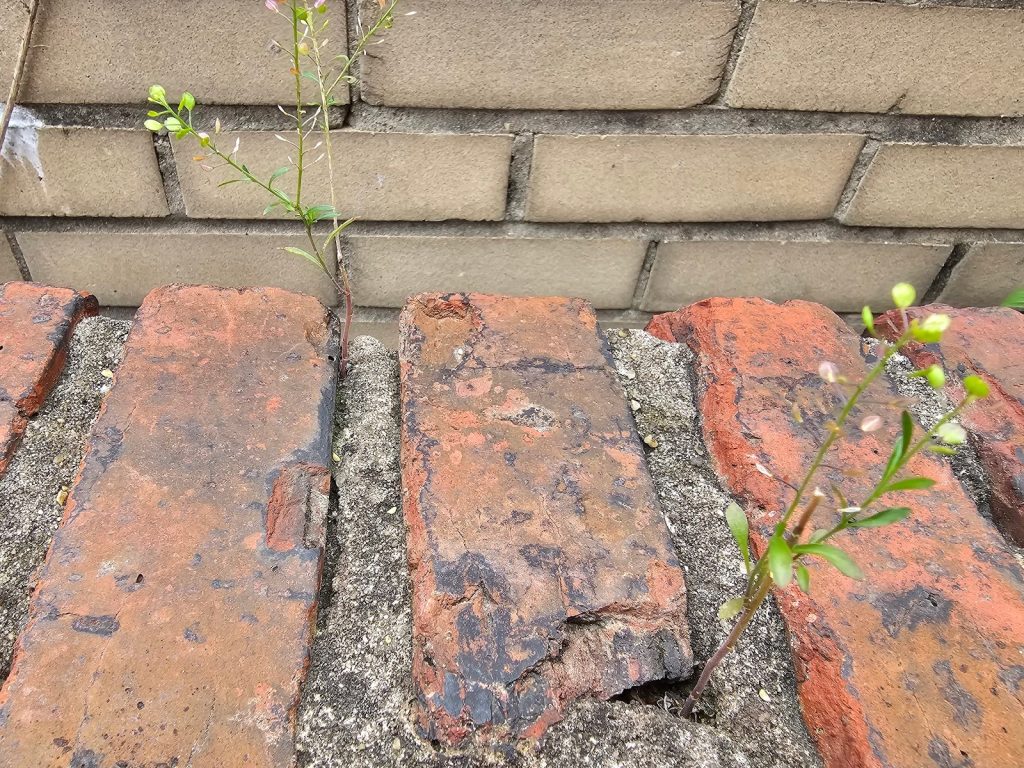
When you look down at the mortar joints closely, these little plants could almost look harmless. They’re small and weak. They’re about the size of little blades of grass. They can easily be picked out just by yanking on them with your fingertips, but just because they’re small now doesn’t mean they’re harmless. In fact, some of these little plants are tree saplings, just taking root. As they grow, they will have a root base that expands with such strength and force that it can break the masonry apart. As we mentioned, proactive repointing would solve this problem.
The recess and the remaining deteriorated mortar would be removed and filled with a newer mortar. In this particular case, that newer mortar has to be compatible with the adjacent historic brickwork. For the reasons of compatibility and professional application, we highly recommend using a contractor such as ourselves who cares about doing this restoration work properly.
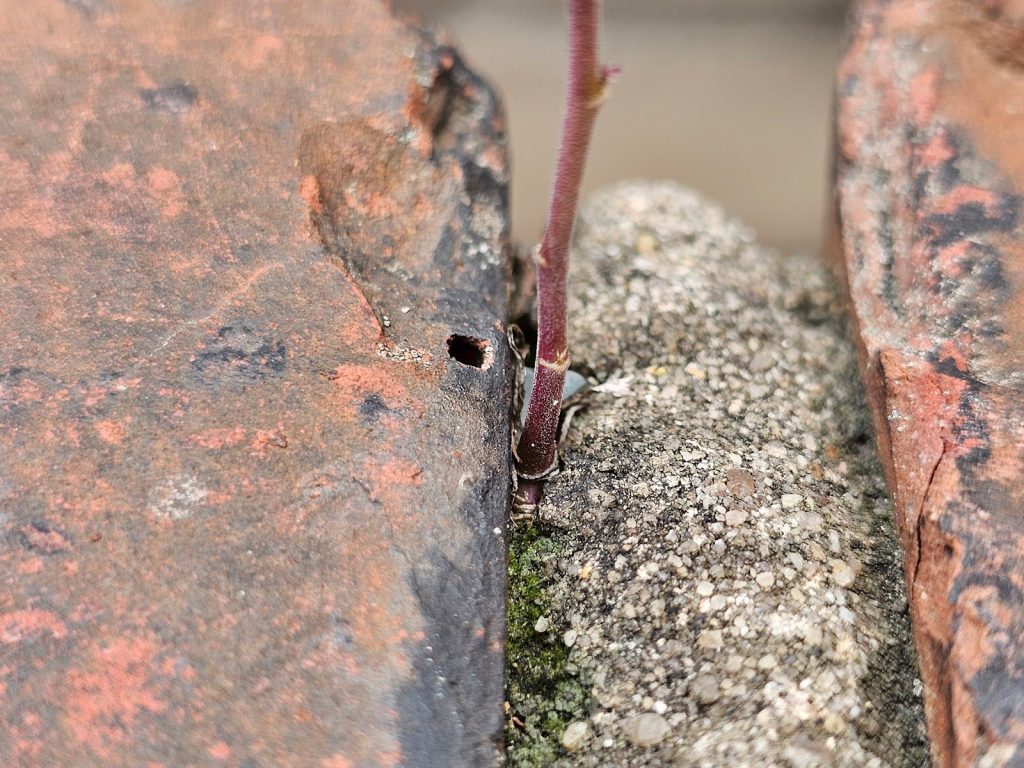
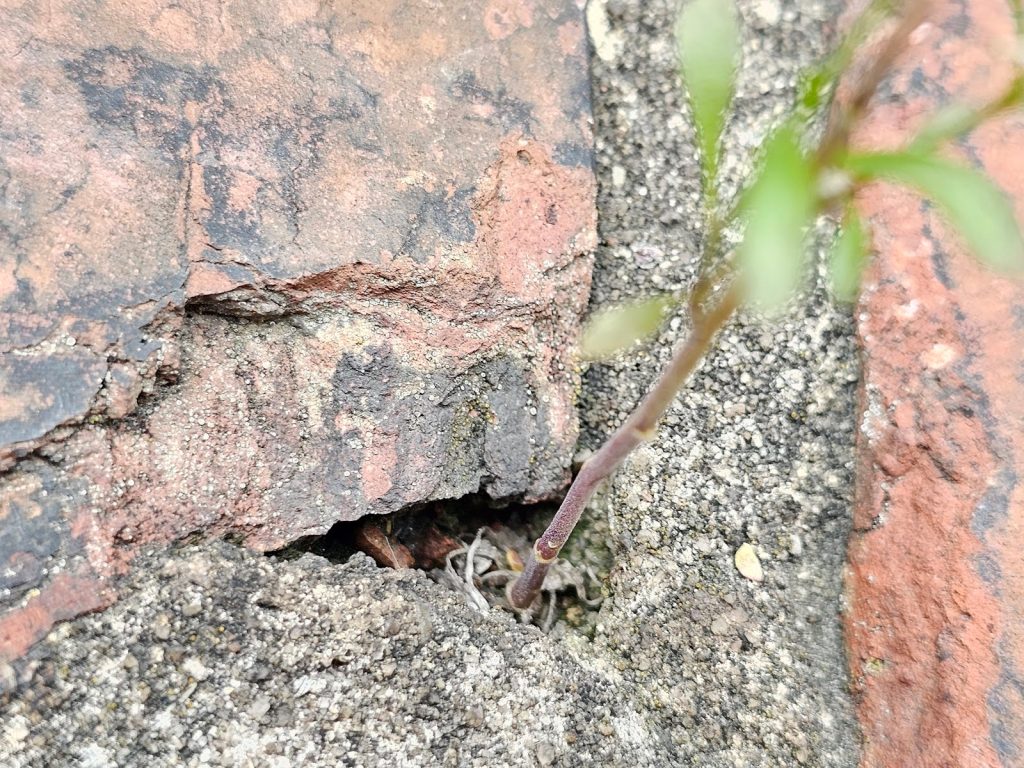
You can look at the area where the brick has chipped away. It’s likely here that as the mortar deteriorated just a tiny bit, water entered into the small pocket. As water entered, over many iterations in our icy cold wintry months, many freeze-thaw cycles happened, coincident with precipitation. Each one of those cycles leads to more damage. As the damage increased, the pocket got a little bit deeper. As the pocket got just deep enough, a seed got caught into the pocket. As the seed is now growing it is continuing to cause more and more damage, even at an increasing rate.
We can Help
Our company focuses on historic restoration more than modern building upkeep, maintenance, and construction, but our company understands both types of construction very well and a full picture well-rounded approach is needed in any niche in the construction industry. Although we focus on historic restoration, repointing, tuckpointing and historic brick repair, our company also has technical knowledge and competencies in the areas of modern and contemporary construction as well as we become one of the leaders in that area of the market today. Understanding both historic and modern or contemporary construction is useful because both aspects help understand the challenges and potential solutions for challenges in building science and construction.
We can help with a variety of historic masonry restoration needs and upkeep, from modest tuckpointing and or repointing to complicated and extensive historic masonry restoration. Infinity Design Solutions is a historic restoration contractor in Washington DC specializing in both historic masonry restoration such as tuckpointing our repointing, and brick repair. If you have questions about the architectural details or facade of your historic building in Washington DC, reach out and say hello and if we can help we’ll be glad to assist you. You can email us or call us on the telephone at the following link: contact us here.