
Insights on Projecting Horizontal Bands in Masonry Facades
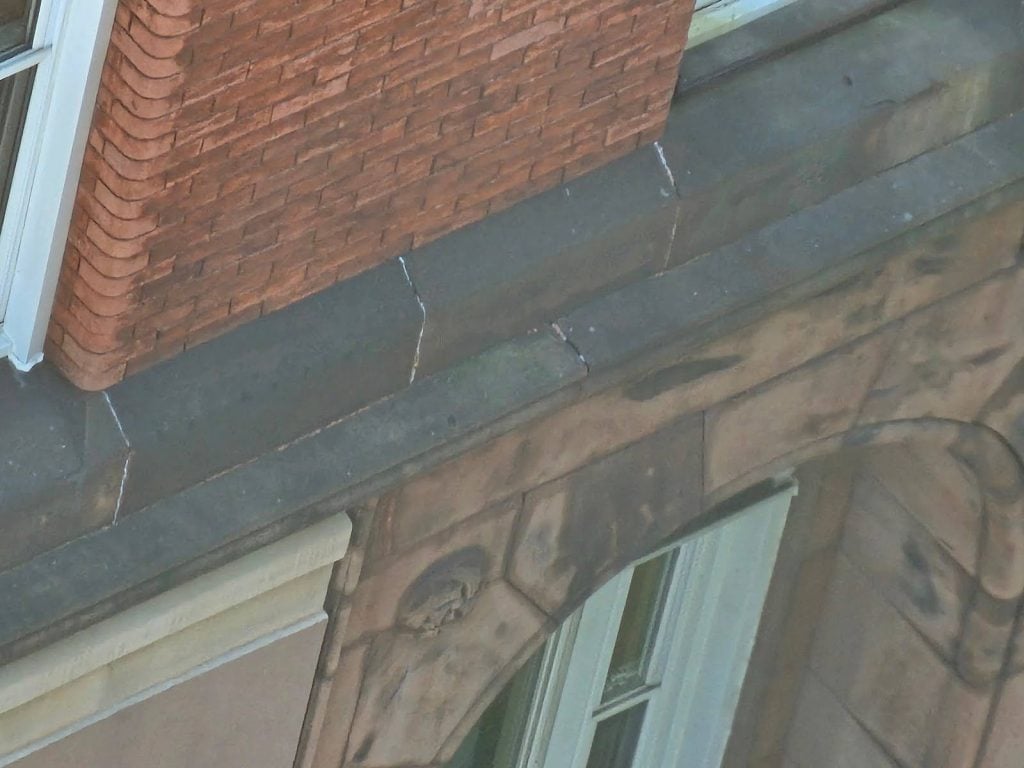
This particular article is going to be about the pathway that water takes dripping off of these projecting ledges, but it’s a follow-up after last week’s article. Here, we show some of the same details of the projecting ledges but from a higher angle. From here, you can get a better sense of how far they project and how water flows as it runs down the face of the building. We also, last week, mentioned that the particular brick masonry of this particular facade needs to be repointed. We strongly recommend people be proactive and repoint before it is absolutely necessary. Here they waited too long. They should have done it before the mortar joints became so recessed.
Exposure to both time and moisture has a lot to do with the deterioration of mortar joints. If you look at this particular facade, you can see how this demarcation point works as a transition from stone at the lower portion of the front facade to the brick above. The brick is not protected by the extending edge of the decorative ovolo cove. As water drips down the front facade though it will land on this projecting element and then from there run out to the edge and fall off the edge.
It works a little bit like a drip edge, in modern types of construction. Modern drip edges are particularly made, with different types of elements, to have an extending point that is both extended out farther and lower than all other elements in the contiguous assembly.
In some cases, stone elements were carved with a kerf at the underside of the projecting sill edge. You can think of a kerf as a small cut into the underside surface of a sill. This cut is left open at the underside of the sill and when water runs down the face of the sill, it has a tendency to go backwards at the lower corner, into the horizontal direction back towards the building, it will stop at the kerf and drip off.
Water can run horizontally, pretty easily. It can even be sucked upwards through capillary action and or absorption, but water doesn’t generally run upwards without one of the somewhat unique types of conditions either capillary action, absorption, or significant pressure differentials at openings.
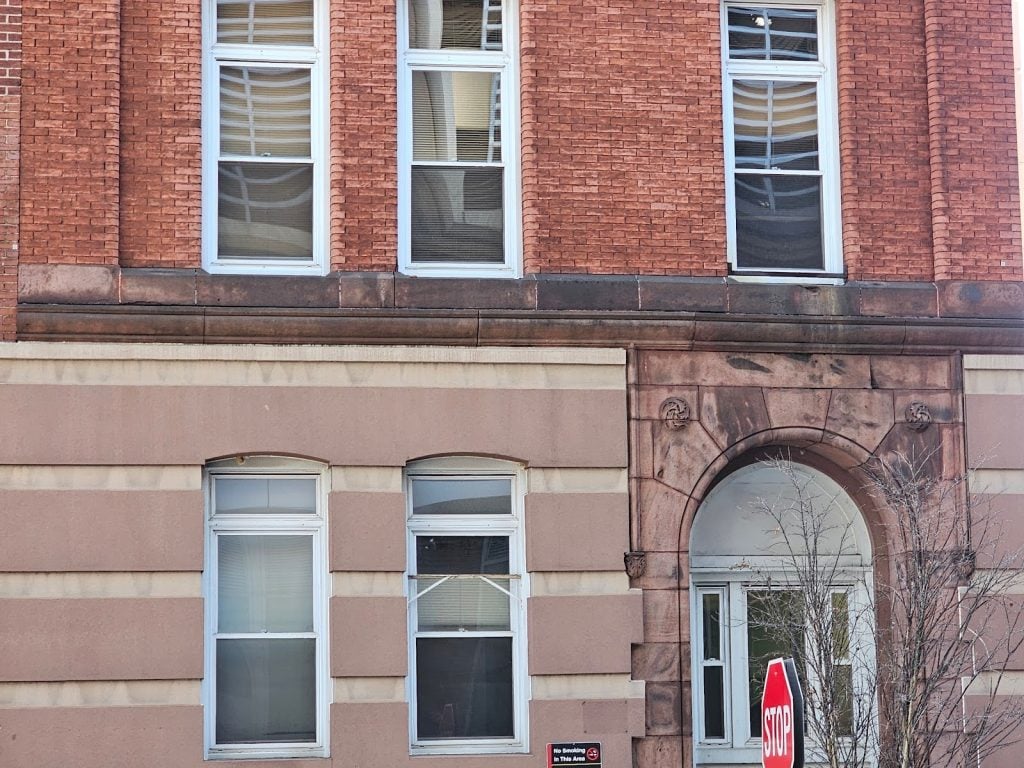
The projecting edge then kind of works to protect the elements below. When there’s wind driven rain, the water will blow back towards the face of the building, but most rain patterns do not necessarily have high amounts of coincidence wind. The majority of typical rainfall and precipitation will happen without being blown about by the wind. In the majority of those cases, then, a large portion of the facade can be passively protected just by the projections.
The picture below looks at the same projecting ledge, but here we’re looking at it from a higher angle. Looking down, you can see the edge closer to what it might look like in a plan view. The sills connect directly to the frieze. Both are made with a brownstone type material.
Looking at the picture above, we’re not sure of the time of the installation of that lower level facade. We think it’s likely that this area was modified. The entry door looks to be original, but the area of masonry just at that lower level, not inclusive of the door, does not look to be original. It looks like something that was made many years after the original construction with a sort of style that looks original, but it’s not.
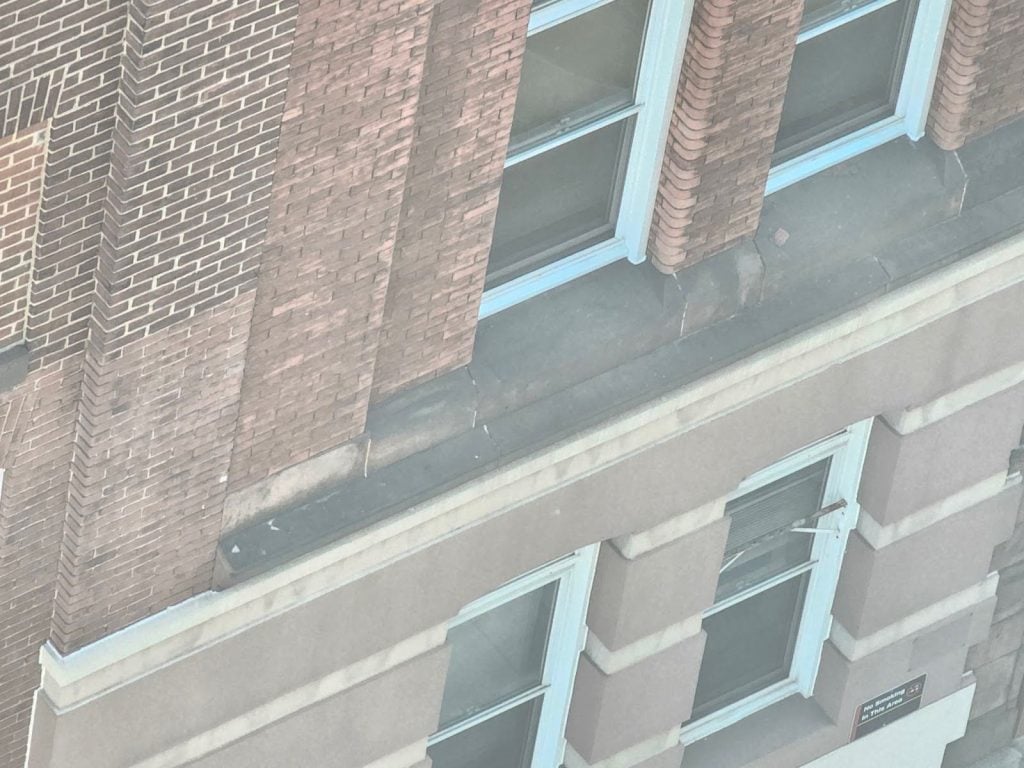
In the same way that projecting ledge helps the area below to avoid excess exposure to hydration, the projecting ledge is exposed. That’s a spot that’s not protected. Instead of staying out of the way, this projecting ledge sort of sacrifices itself. It takes more damage than it would otherwise by projecting out. It’s a relatively thick stone though, and unlike the masonry below, has very few mortar joints and mortar joints are intended to be sacrificial but also most susceptible to deterioration and damage.
Also, like a regular windowsill every part of this projecting ledge has a bit of unlevelness, intentionally. It’s made to be graded down away from the building. Essentially if and when water lands on top of the ledge, it naturally drains away towards the front. If it were actually built flat then water would puddle up there, and deteriorate at the spots where it were building up.
We can Help
Our company focuses on historic restoration more than modern building upkeep, maintenance, and construction, but our company understands both types of construction very well and a full picture well-rounded approach is needed in any niche in the construction industry. Although we focus on historic restoration, repointing, tuckpointing and historic brick repair, our company also has technical knowledge and competencies in the areas of modern and contemporary construction as well as we become one of the leaders in that area of the market today. Understanding both historic and modern or contemporary construction is useful because both aspects help understand the challenges and potential solutions for challenges in building science and construction.
We can help with a variety of historic masonry restoration needs and upkeep, from modest tuckpointing and or repointing to complicated and extensive historic masonry restoration. Infinity Design Solutions is a historic restoration specialist contractor specializing in both historic masonry restoration such as tuckpointing our repointing, and brick repair. If you have questions about the architectural details or facade of your historic building in Washington DC, reach out and say hello and if we can help we’ll be glad to assist you. You can email us or call us on the telephone at the following link: contact us here.