
Understanding Structural Stability in a Masonry Facade
This past week we also took a look at the steel and cast iron resistance plates shown in the pictures below. You can reasonably infer that this large steel plate has been installed after the cast iron star. This steel plate works similarly to the star. The plate happens to be much larger though. We believe that the contractor here installed the large plate after the installation of the star. By comparison, the steel plate doesn’t share any of these particular aesthetic elements found in the cast iron star. Normally, cast iron is more decorative than other types of miscellaneous metals.
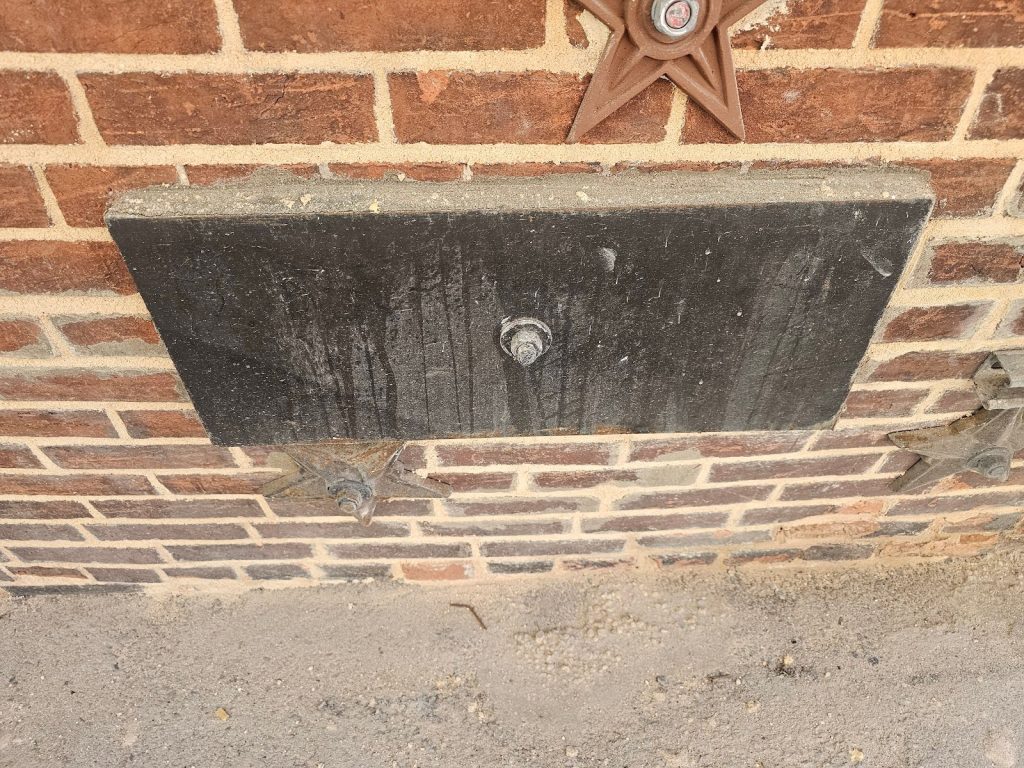
In the picture below, you can see a closer view of the nut and the washer. The washer, in this particular case, happens to be a lock washer. Lock washers have a particular advantage over regular flat washers. Lock washers can prevent the future slippage and separation of the nut from the bolt. Over time, with slight vibration, it’s not uncommon for washers to become loose.
If you look closely at the surface of the bolt, nut, and washer, you can see that these elements have not actually been painted. There’s a coating on the surface of these metals, but it’s not the intended finish coating. Instead, it’s a coating from the manufacturing or from the initial priming. In the case of the star, for example, it has an initial red primer. Red primers are applied to metals to protect them and provide a base coat of coverage, but it’s not the same as final paint.
It doesn’t resist exterior elements and or deterioration or oxidation as much as final coats. The practice goes back all the way to the early years of implementation of mass produced metal elements in construction. There’s supposed to be at least one additional coat of paint applied as well. We encourage application of two or more additional coats, we feel that the coverage is more consistent and does a better job to protect the substrate when additional coats are applied.

The picture below shows an oblique angle looking horizontally cross the face of the vertical facade. Here you can see a few different issues that are important. First, the mortar looks like it hasn’t been properly cleaned from the face of the brick, after application. As we discussed last week, this wall has been repointed. Masonry repointing is the process of removing the exterior most deteriorated mortar and replacing it with newer mortar. The new mortar needs to be compatible with the substrate mortar for repointing to be done properly.
This particular detail or facet of repointing is extremely important. Repointing without proper compatibility can be detrimental to the building. Most people don’t understand how much damage can be caused by repointing without proper mortar compatibility, but it’s simply imperative.
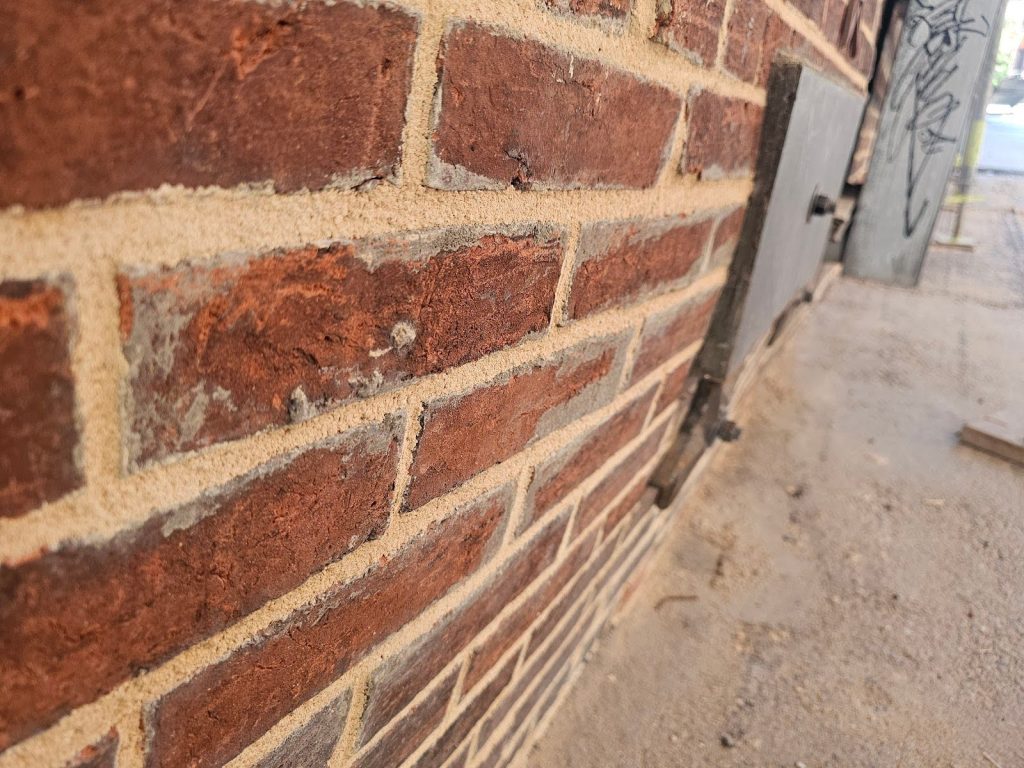
When we see sloppy mortar smeared across the face of bricks, it’s a red flag. It doesn’t mean that the mortar isn’t compatible, but it means that the mason who started this work either wasn’t able to finish and provide a cleanup (and that’s a weird scenario because it infers that something else was going on wrong during the project), or it means something worse.
Another potential scenario is that the contractor wasn’t a professional and detailed contractor who cared about things like doing work that looks aesthetically correct. If they don’t care about the aesthetic of their work then it’s also likely to infer or assume that they may not care about other important things like the compatibility of the mortar they used. These are very concerning signs because if the mason doesn’t care about their work then they may not have used the right mortar in the wrong mortar can be devastating to a building.
Looking across the wall, horizontally, you can see that there is a significant bow in the wall, it’s like a fat potbelly sticking out away from the otherwise flat plane that wall. It just looks problematic, but the underlying causes are even more concerning.
Problems of lateral deflation like this are generally caused from one or more of a few general types of deterioration and or destabilization. In many ways, in many cases, deterioration like this can be stopped in it’s tracks early on if historic masonry is simply repointed on a proactive timetable. Without repointing, moisture enters into the mortar joints and causes deterioration. Over time, this alone can be a factor that leads to destabilization and lateral deflection of a wall. These types of problems can lead to failure and collapse of a building.
We can Help
Our company focuses on historic restoration more than modern building upkeep, maintenance, and construction, but our company understands both types of construction very well and a full picture well-rounded approach is needed in any niche in the construction industry. Although we focus on historic restoration, repointing, tuckpointing and historic brick repair, our company also has technical knowledge and competencies in the areas of modern and contemporary construction as well as we become one of the leaders in that area of the market today. Understanding both historic and modern or contemporary construction is useful because both aspects help understand the challenges and potential solutions for challenges in building science and construction.
We can help with a variety of historic masonry restoration needs and upkeep, from modest tuckpointing and or repointing to complicated and extensive historic masonry restoration. Infinity Design Solutions is a historic restoration specialist contractor specializing in both historic masonry restoration such as tuckpointing our repointing, and brick repair. If you have questions about the architectural details or facade of your historic building in Washington DC, reach out and say hello and if we can help we’ll be glad to assist you. You can email us or call us on the telephone at the following link: contact us here.