
Asphalt Paving Adjacent to Historic Masonry – Part I
In the past, we have looked at many of the different ways that historic brick buildings face the environmental threats of deterioration. Today we’re going to look at a particular issue where a historic row home is attached to another building on one side but is against an alley on the other side. Essentially this building has three facades that are exposed to the elements: the front, the rear, and a long side facade.
The alley has been modified and changed throughout the decades since the original construction of the building. It’s likely that at the original construction, in roughly the 1890s early 1900s, there was cobblestone paving in the alley. Since then, the alley paving has probably been changed a few times. Now, there is a black asphalt paving, essentially similar to a typical DC roadway. It’s likely the elevation of this paving has increased at least slightly.
The asphalt paving basically just abuts up to the side of the brick building. There’s a gap or space though between the brick and the asphalt. Asphalt remains somewhat flexible throughout the majority of his lifespan. After the initial placement and positioning and fine grading of the asphalt it will begin to cure. The curing process takes time, but even after the final curing, the asphalt will move a bit with thermal changes. Asphalt also has a moderate tolerance for the substrate conditions and movement from external physical elements.
Asphalt remains a bit more flexible than typical building materials. Here though, after the asphalt began to cure, it began to shrink and now there is a gap at the buildings on both sides of the alley, between the alley asphalt paving and the brick facades of those buildings.
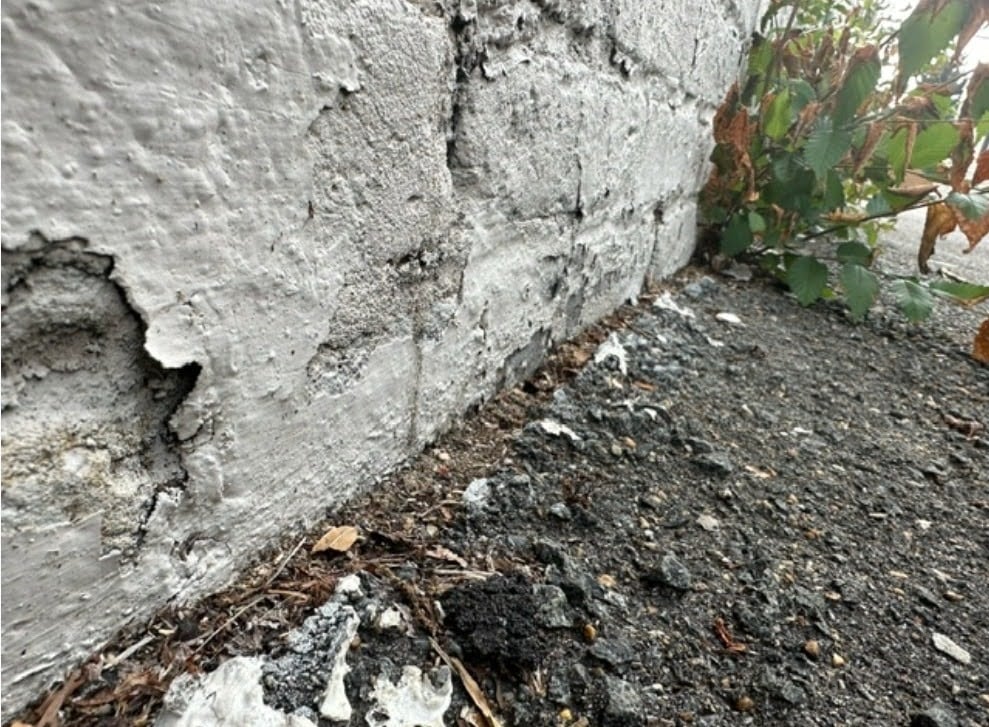
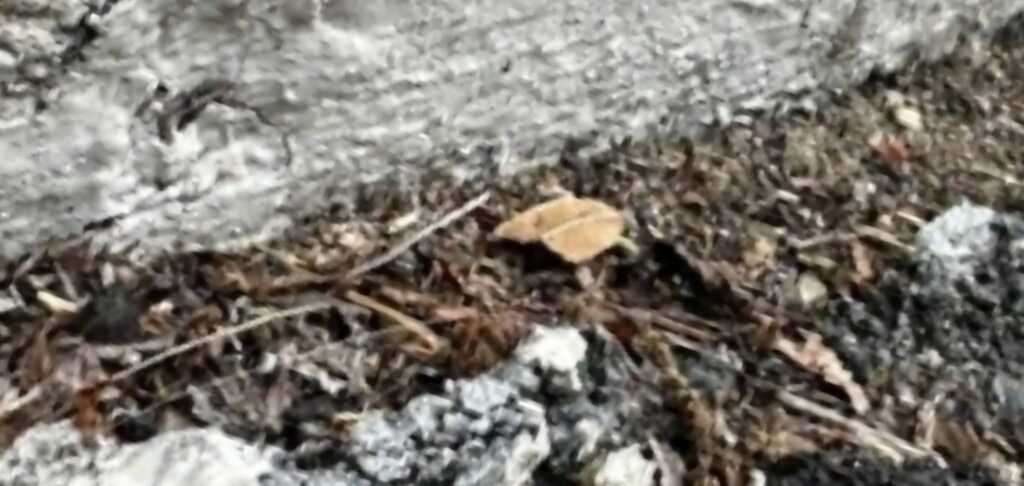
Here, there’s a gap that’s roughly three quarters of an inch thick. You can see that space is filled up with debris and plant vegetation scraps. Those materials have fallen and begun to fill that interstitial open space. It might look like they’re doing a good job of filling the space, but they’re actually problematic. They work a bit like a sponge. The problem with a sponge is that it’s not impermeable. Instead it has the opposite type of nature.
A sponge will wick and retain water or moisture. Here, for example, every time there is significant rainfall, that material will become wet and it will allow moisture water to pass through down between the asphalt and or alley substrate materials and the historic brick wall. Those mortar joints are aged and therefore somewhat deteriorated. Even now that attention is being applied to the condition of the building, it’s hard to simply repoint those old historic mortar joints where they’re buried beneath the asphalt paving.
In this coming week we’ll look at additional photographs and talk more about why permeating and trapped water is problematic to historic masonry. We will also talk about some of the common methods of repair to this type of complicated problem. In this case, it’s not easy just to demolish and redo the asphalt, nor is it effective to pour more asphaltic materials into the crevice or space.
To properly maintain, repair, and care for these historic buildings, a knowledge, interest and understanding of historic building principles is required. Here in Washington DC, historic masonry buildings are extremely expensive and the amount of financial loss caused by improper repointing and low quality construction is staggering. However, in addition to the direct financial value of the property, there is also a cultural loss when historic buildings are damaged. By comparison, consider neighboring poor cities, when historic buildings are damaged, it’s not just the loss of value to the property owner, there’s also a loss to all inhabitants and visitors of a city, present and future, who care about architecture, history, and culture.
We encourage all of our clients, and all readers of this article and to our blog in general, to prioritize the historic built environment of Washington DC and neighborhoods such as Capitol Hill, Dupont Circle, and Georgetown and become educated on on the difference between proper historic preservation versus improper work which leads to significant damage to the historic fabric of a building.
From a conservation and preservation perspective, several approaches can be taken to improve conditions related to deteriorated historic brick masonry. Primarily, lime mortar brick joints and low temperature fired soft red clay bricks should be inspected and checked on a routine maintenance schedule, either seasonally or at least annually. If brick masonry is kept in good condition, the life of embedded wood elements can be significantly extended. Hire a professional contractor which specializes, understands and appreciates historic construction elements and buildings.
You can learn a lot more on our blog. Feel free to check it out. If you have questions about the historic masonry of your building in Washington DC, fill out the webform below and drop us a line. We will be in touch if we can help.