
Open Asphalt Paving to Brick Wall Joint Repair
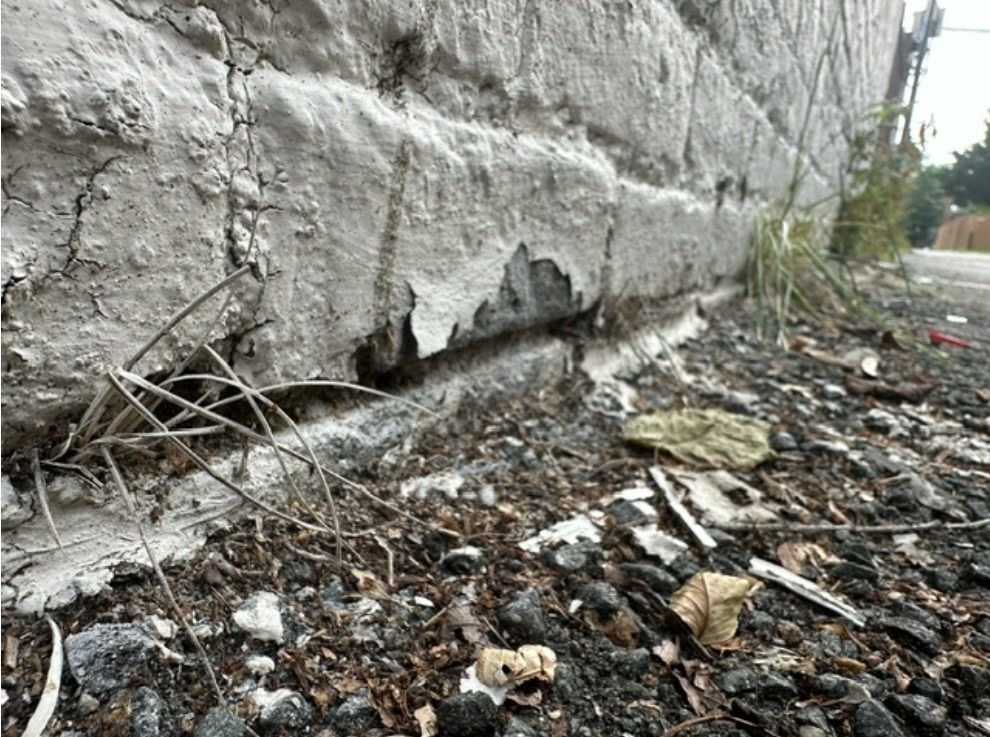
This past week, we looked at photographs of a historic brick masonry wall alongside an alleyway. The base of the wall had an open joint between the asphalt and the brick masonry. Essentially the vertical brick had an open space that separated it from the asphalt and the crevice between those two materials was filled with tree debris and dust. That crevice was a place where water could enter into and then permeate down farther into the brick wall and under the roadway.
As this trapped water permeates into those materials, it’s in a space where it doesn’t dry out quickly, because of all the building materials around it, sunlight and warmer temperatures do not access that space as well as they would otherwise. It’s essentially trapping the water into that crevice.
This type of trapped moisture is problematic not just because it doesn’t dry out or relieve itself naturally, also because it infiltrates further into the brick and masonry materials which causes slow but consistent damage and deterioration.
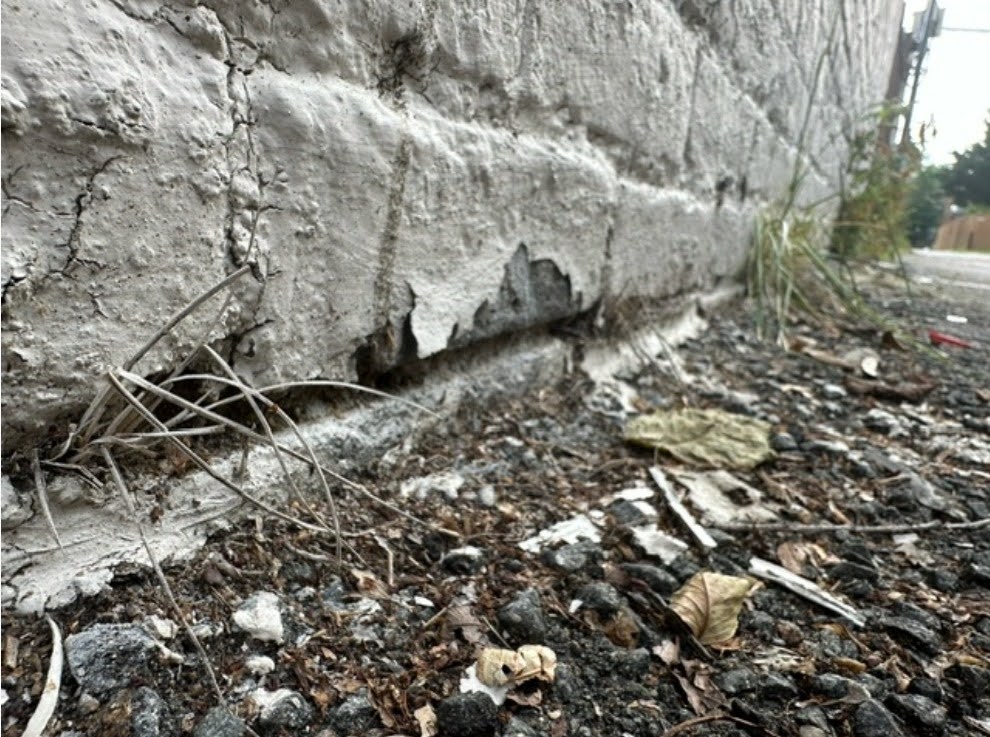
There are a few different types of mechanisms of deterioration of historic brick masonry related to excessive moisture. We often look at repointing as one of the primary methods of restoration of historic brick masonry. Repointing removes deteriorated mortar at the outer face of the wall. As mortar is replaced in the repointing process, it revitalizes the masonry. Essentially, by replacing deteriorating mortar with better mortar, of compatible characteristics, it provides a new layer of defense. Here, though, an area adjacent to paving, the area of deterioration of the historic masonry footing, the old deteriorated masonry and mortar cannot be accessed. You just can’t get down to it without breaking up and digging out the alleyway.
One of the primary mechanisms of deterioration related to trapped mortar and historic masonry is damage from the typical freeze-thaw cycle that happens throughout our bitter winters.
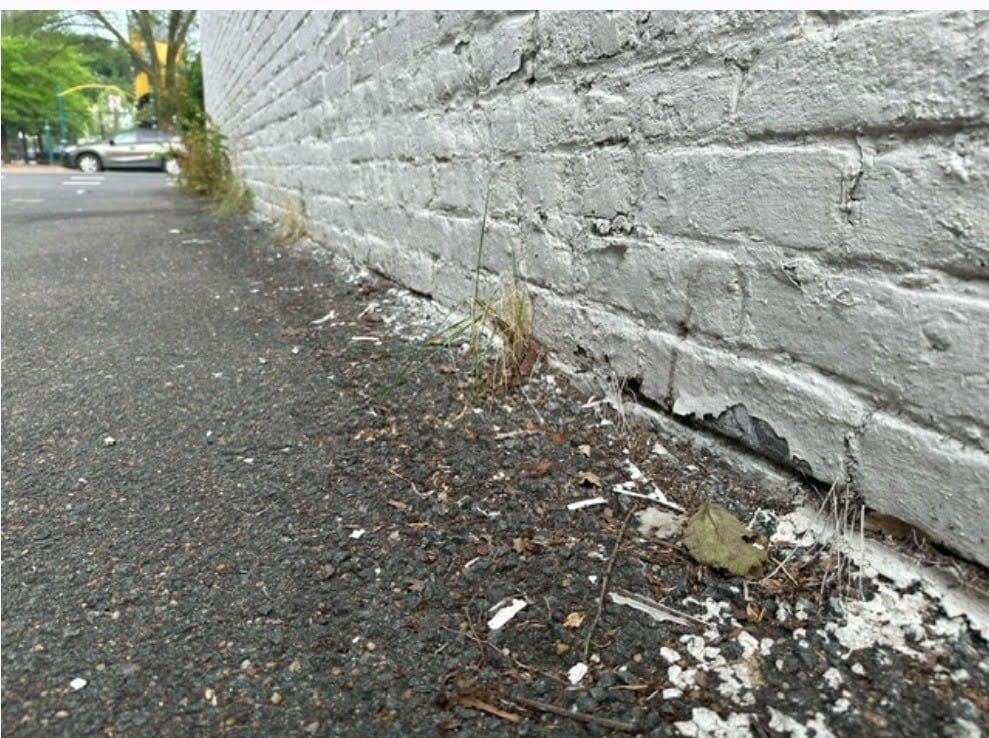
Another one of the main mechanisms of deterioration is related to plant growth. Often we’ll talk about the deleterious effects of biocolonization on historic mortar and masonry. See in the picture below, complex plant life is already taking root into the small crevice between the asphalt and the brickwork. When complex plant life such as this American Elm sapling shown in the left side of the picture below, grows into a crevice like this, it takes root firmly.
American elm grows rapidly and it is extremely hard wood. In the olden days when people used wood stoves commonly, American elm was known to burn so hot that it could warp the door of a wood stove. It simply has a very dense and tough fiber. It is very hard wood that is difficult to cut and it’s difficult to rip out of the ground. In cases like this where the roots cannot easily be removed without tearing the upper branches apart, we would likely recommend the use of a chemical herbicide.
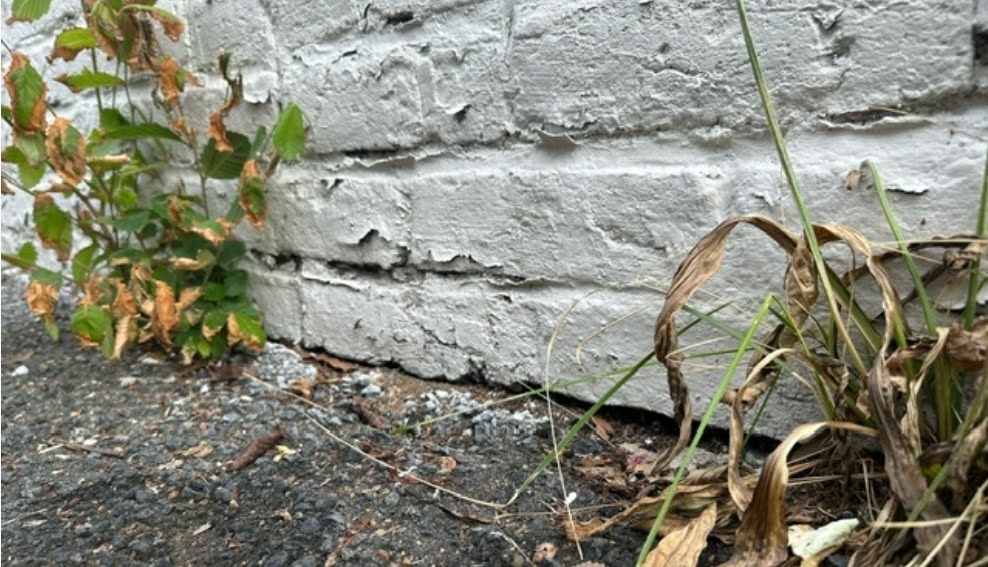
The third type of deterioration associated with excessive trapped moisture is substrate or subcomponent dissolution. The process is known as leaching. Essentially, with excessive moisture, the binding elements of the mortar will break down and the masonry will lose its cohesive qualities.
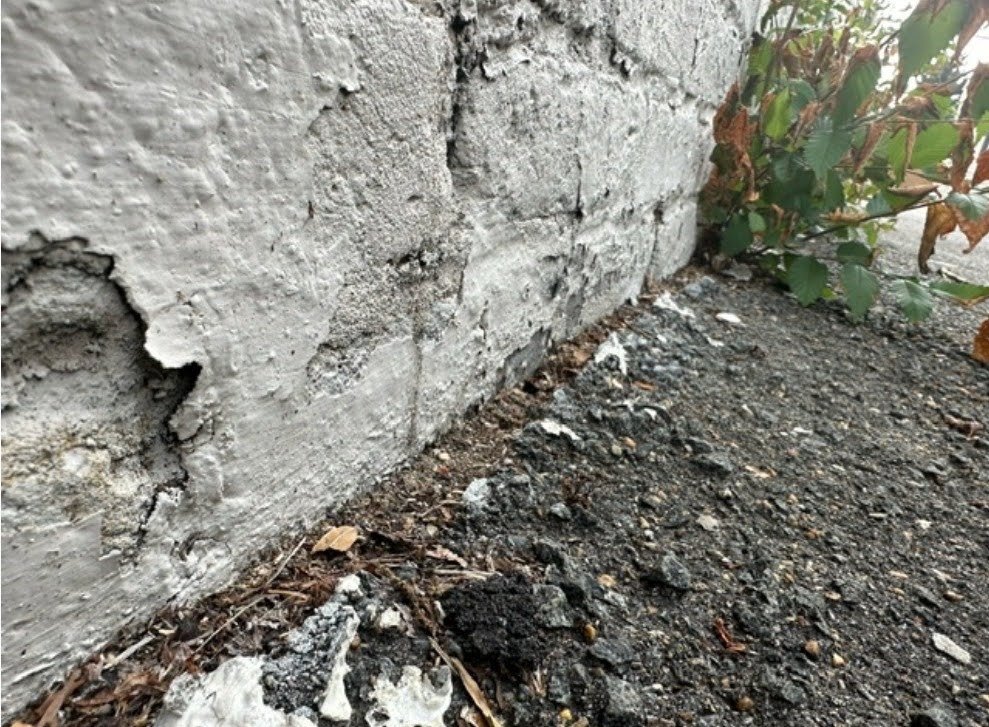
The solution here is to remove the complex plant life and all types of biocolonization in the area between the wall and the horizontal paving. Then, after the larger materials are removed, the substrate must be thoroughly cleaned. A masking should be applied to the adjacent materials on both sides with a spacing of between 1/8 of an inch to 3/16 of an inch. Then an application of an elastomeric or similar type of sealant should be applied. If the crevice is deeper than roughly 3/4 of an inch, a backer rod or similar type of flexible filler should be applied before the application of the sealant.
To properly maintain, repair, and care for these historic buildings, a knowledge, interest and understanding of historic building principles is required. Here in Washington DC, historic masonry buildings are extremely expensive and the amount of financial loss caused by improper repointing and low quality construction is staggering. However, in addition to the direct financial value of the property, there is also a cultural loss when historic buildings are damaged. By comparison, consider neighboring poor cities, when historic buildings are damaged, it’s not just the loss of value to the property owner, there’s also a loss to all inhabitants and visitors of a city, present and future, who care about architecture, history, and culture.
We encourage all of our clients, and all readers of this article and to our blog in general, to prioritize the historic built environment of Washington DC and neighborhoods such as Capitol Hill, Dupont Circle, and Georgetown and become educated on on the difference between proper historic preservation versus improper work which leads to significant damage to the historic fabric of a building.
From a conservation and preservation perspective, several approaches can be taken to improve conditions related to deteriorated historic brick masonry. Primarily, lime mortar brick joints and low temperature fired soft red clay bricks should be inspected and checked on a routine maintenance schedule, either seasonally or at least annually. If brick masonry is kept in good condition, the life of embedded wood elements can be significantly extended. Hire a professional contractor which specializes, understands and appreciates historic construction elements and buildings.
You can learn a lot more on our blog. Feel free to check it out. If you have questions about the historic masonry of your building in Washington DC, fill out the webform and drop us a line. We will be in touch if we can help.