
Common Masonry Mistakes in Historic Washington DC Buildings
A lot of the things we look at here on our website are not just about the work that we do and work well done. We do look a lot at Best Practices in building construction because it’s something that’s really important to us. We believe in the benefits of managing a continuous quality improvement system that leads to increasingly seeing the better outcomes in building construction. It’s proactive and pays dividends because it reduces rework and increases the benefit to our clients. There are many obvious reasons that make it worthwhile to invest in quality improvement.
One of the best way to learn though is by looking at the work of others and understanding their mistakes. So much can be learned by learning from others’ mistakes instead of having to pay for yourself to get up the learning curve. Learning curves are a natural part of improvement and gaining skills, but learning the hard way can be extremely expensive in the construction industry. It’s a lot easier to study what other people do wrong and try to do better, where you can. Specifically talking about construction, here, but the principle applies to a lot of things in life.
The picture below shows a front building facade where the gas contractor took out a large chunk of masonry instead of making a simple clean hole. In the process of replacing the gas line, they could have kept things clean and simple, but instead they damaged a large portion of the Formstone on the facade. Replacing Formstone in kind is not easy because the parts and components to rebuild Formstone haven’t been around in mass production for many years.
Doing a faux replica by hand is extremely tedious and needs to be done in multiple individual layers. Here, to take a shortcut, and to make it much faster and cheaper, but not just make it smooth, they kind of tried to make it blend in a little bit by applying a parge or stucco coat of cement to the front facade where they demolished and rebuilt the masonry. They just created lines that look like courses of brick but it doesn’t match the Formstone. It does look better than nothing, it looks better than just a smooth area since it’s inside of a greater field of formstone. It still doesn’t look right though.
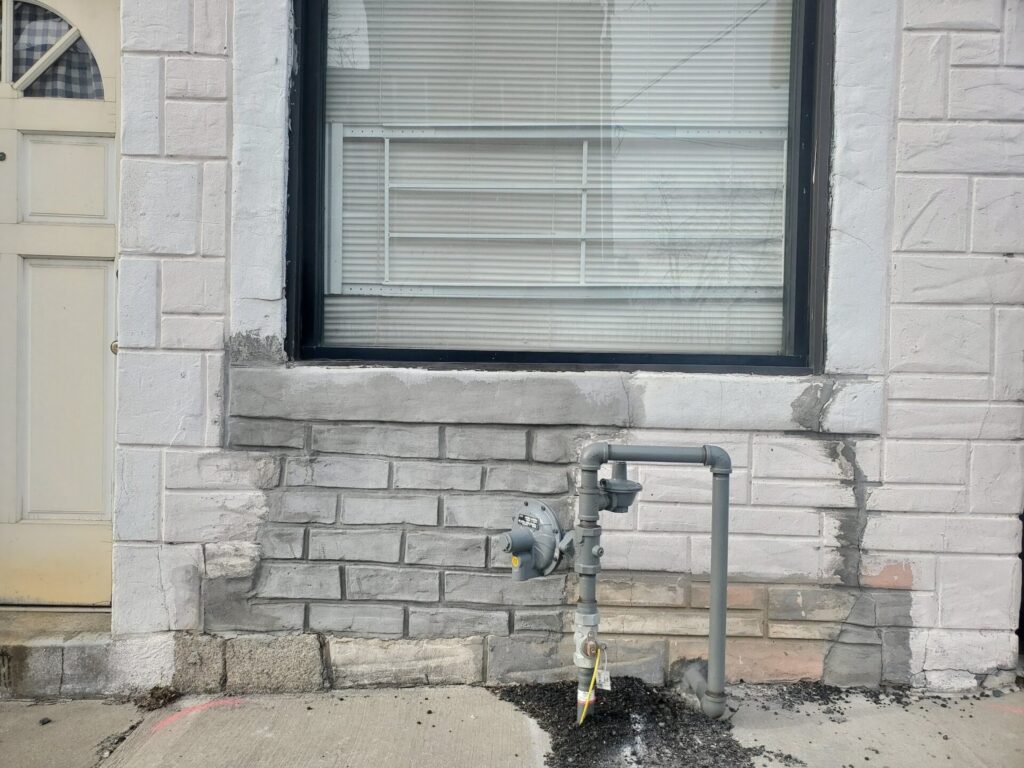
It almost looks somewhat convincing, as a replica of bricks. Except, the handmade brick look has individual bricks that are crooked and have squiggly lines instead of straight lines. The mortar joints replicate a raked mortar joint, yet they are inconsistent. For a really quick application, especially if it’s really cheap, this isn’t terrible, but it definitely doesn’t look good. It doesn’t look anything like the actual thing should.
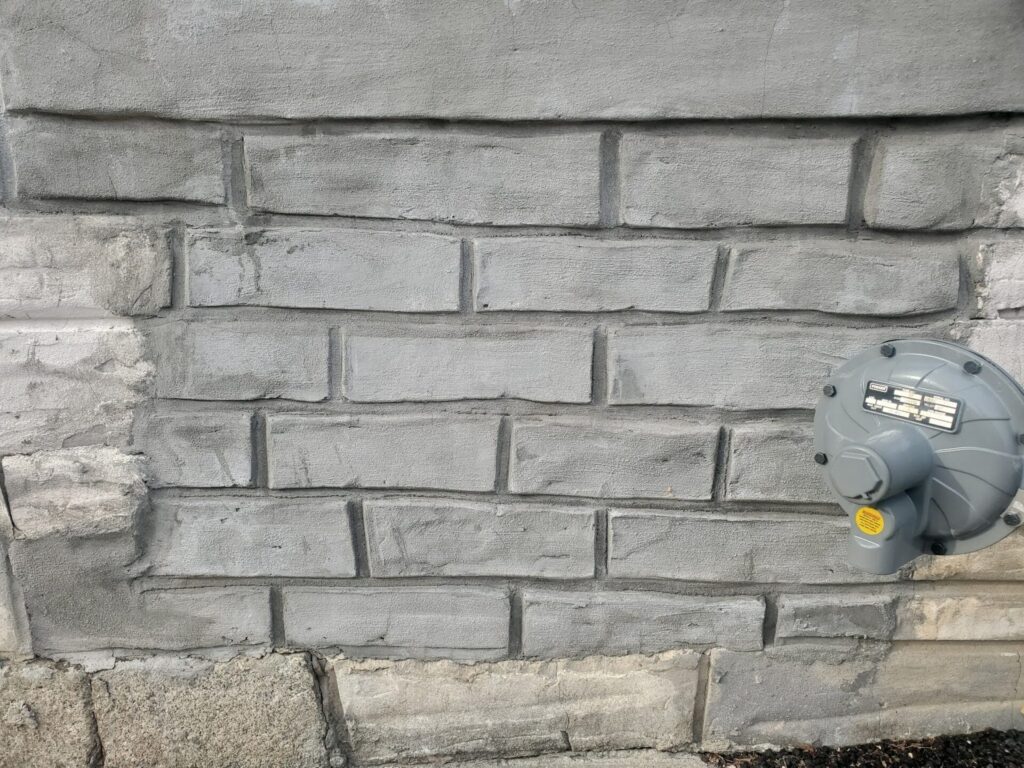
If you look towards the bottom of the picture above, it looks like on the bottom right hand side of the the patch area, they tried to line up the mortar joints, but that doesn’t make any sense. It wouldn’t make sense to line up a mortar joint of a stone course or in this case Formstone course of masonry if the Formstone has a significantly different height than the height of the brickwork. Brickwork is roughly 2.25 inches tall. With a normal mortar joint, it was roughly 2-5/8 inches tall. Here, the form stone was about 3 to 6 inches tall. And it had significant variation from one course to the next.
In a future week’s blog article, we’ll take a look at some other examples of bad shortcuts taken in masonry and building restoration and renovation. The issues we’re looking at really all apply to the exterior masonry facades. In some cases, these bad retrofits are related to trying to accommodate new utilities and systems into the building through the masonry facade.
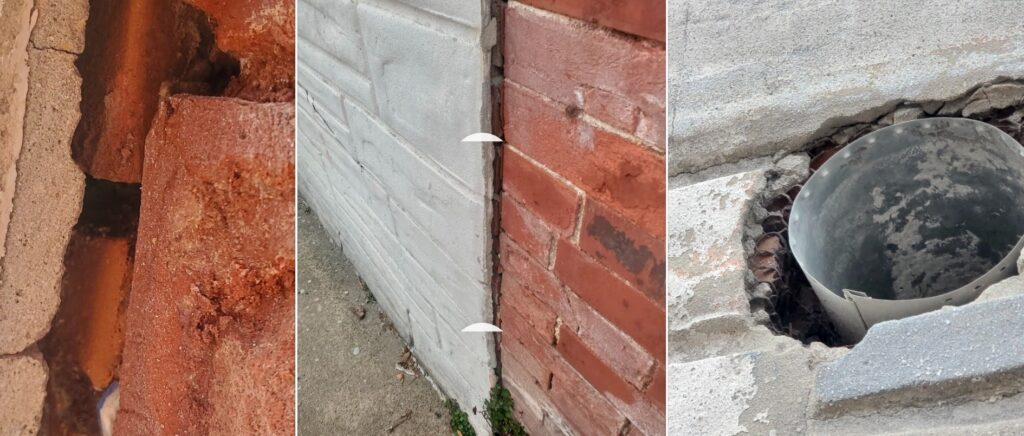
To properly maintain, repair, and care for these historic buildings, a knowledge, interest and understanding of historic building principles is required. Here in Washington DC, historic masonry buildings are extremely expensive and the amount of financial loss caused by improper repointing and low quality construction is staggering.
However, in addition to the direct financial value of the property, there is also a cultural loss when historic buildings are damaged. By comparison, consider neighboring poor cities, when historic buildings are damaged, it’s not just the loss of value to the property owner, there’s also a loss to all inhabitants and visitors of a city, present and future, who care about architecture, history, and culture.
We encourage all of our clients, and all readers of this article and to our blog in general, to prioritize the historic built environment of Washington DC and neighborhoods such as Capitol Hill, Dupont Circle, and Georgetown and become educated on on the difference between proper historic preservation versus improper work which leads to significant damage to the historic fabric of a building.
From a conservation and preservation perspective, several approaches can be taken to improve conditions related to deteriorated historic brick masonry. Primarily, lime mortar brick joints and low temperature fired soft red clay bricks should be inspected and checked on a routine maintenance schedule, either seasonally or at least annually.
If brick masonry is kept in good condition, the life of embedded wood elements can be significantly extended. Hire a professional contractor lie Infinity Design Solutions LLC who specializes, understands and appreciates historic construction elements and buildings.