
Historic Building with Wood together in Masonry – Part I
Today we’re looking at a really old historic building, built before almost all of the buildings here in Washington, DC. To be completely accurate, there are a few buildings here in DC that are much more historic than the rest. This particular building happens to be a log cabin that was skinned over with siding, years after it was originally built. The foundation and the chimney and hearth of the fireplace are built with historic granite stone. The building has both a root cellar and a main living level. It’s a perfect example of early American building construction.
Even though our company specializes in historic brick restoration and repointing more than anything else, we think it’s essential to understand the wide range of historic buildings. The particular building that we’re looking at today provides a very interesting counterpoint to typical Washington DC building assemblies. Knowing how this alternative type of building was put together as a predecessor to the more prolific brick shell buildings in Washington DC helps people like ourselves, and other interested building owners, understand their own architecture.
As we mentioned above, there are clearly some modifications that were done to the building after the original construction. However, unlike the vast majority of buildings right here in Washington DC where modifications mostly happened in the mid 20th century, these modifications here were likely done almost 100 years before that. Back, way over 100 years ago, when log cabins were built, they were mostly hand-hewn. That means that they were planed with hand tools, not milled with the industrial equipment that gave birth to the rise of Victorian style balloon framing, here in the United States. Hand-Henning these structural framing members gave them a surface that was much less consistent than the mill produced lumber.
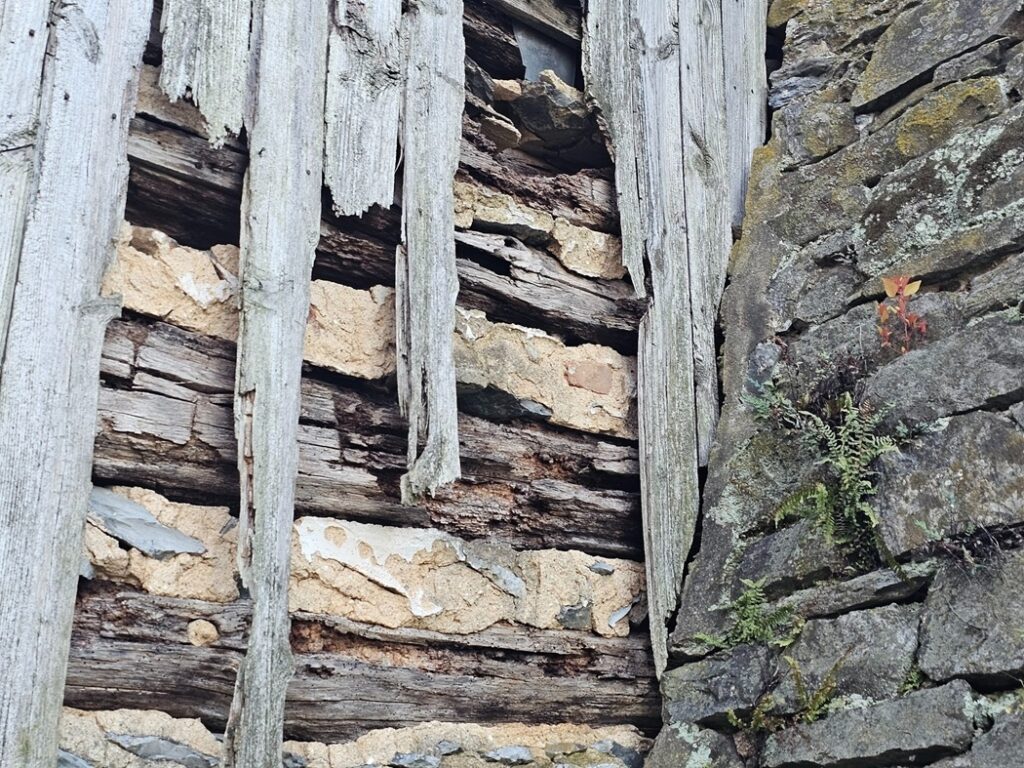
A critical part of these buildings is that unlike a completely stone or masonry-built building, timbers would sit one next to each other and would be intended to leave little to no space. They couldn’t seal it perfectly though. These Timbers work both as the exterior wall finish and the interior wall finish. So there were no other real significant parts of the building assembly other than chinking. Chinking was a mixture of mud and some binder, often using lime and plant material to create an almost Adobe-like type of matrix that held together a little bit better than just pure mud.
Essentially, to fill in the gaps this clinking would be tucked and forced into the gaps between the timbers. Even after being hand shaped, the timbers would still have a relatively round surface where one would meet on top of the next. This meant at those connection points, the wood thickness was very thin and with the inconsistencies they would generally be significant air gaps.
During the bitter cold winters, here in the Washington DC region of the world, living inside of these houses, even with a raging fire burning in the fireplace, the low temperatures would still be painful. Bitter cold, in our humid climate zone, coupled with high winds is tough to bear. Years ago they did it though, they just suffered through the cold. When they had the options to use techniques like chinking, they employed the process well because without it the cold would be much more painful.
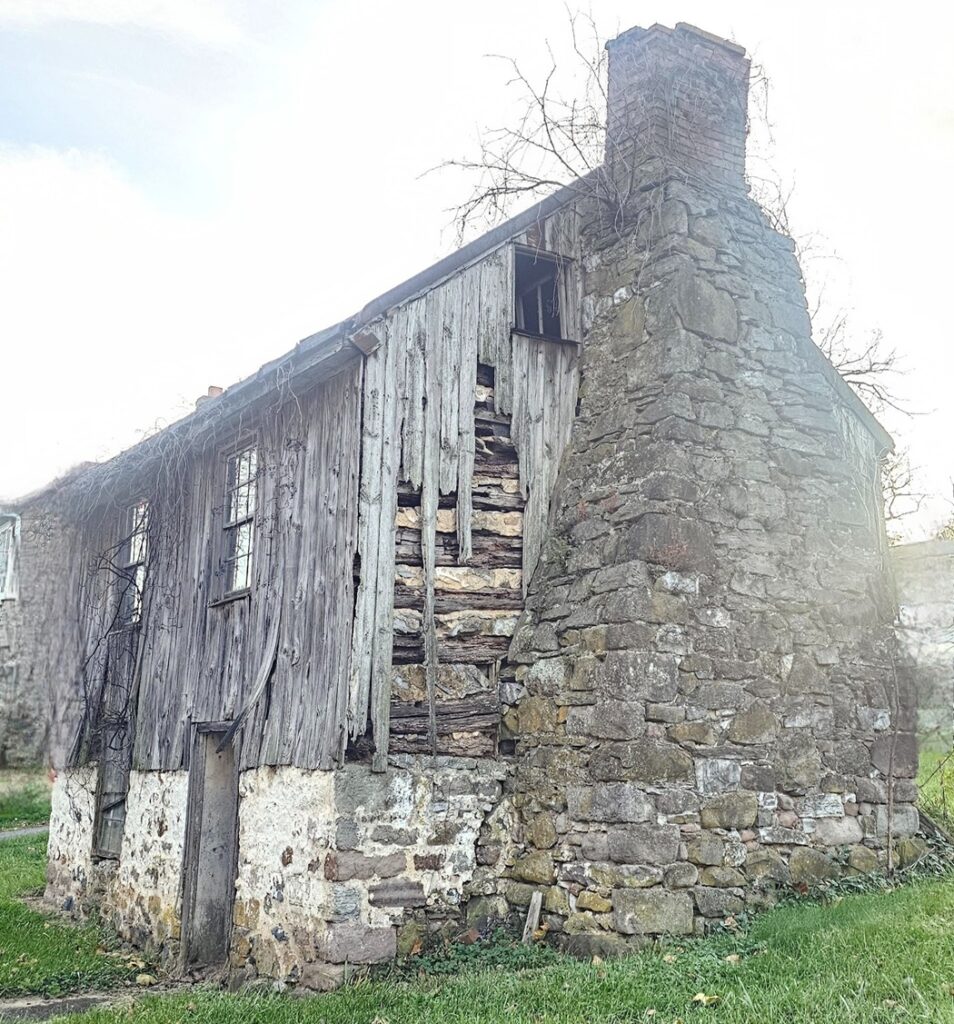
The pictures above and below show several different aspects of this building construction. The siding here is very different from a typical lap siding. Lap siding is made with materials that may happen to be very similar, but the configuration is different. In the case of lap siding, the siding is made from thin planks. Those planks, even in historic times, were essentially milled, and milling is done much easier with mechanized tools, either from mills that are powered from water flow or from other types of mechanized power sources.
For functional purposes, the lap siding will have one board installed at the bottom and then the next board installed above, in the shape of a plank, will overlap the top of the lower siding. This is why it’s called lap siding. By installing every board just a little bit on top of the board below, it helps so that rain, when running downward, does not enter in through the joints in the boards.
To properly maintain, repair, and care for these historic buildings, a knowledge, interest and understanding of historic building principles is required. Here in Washington DC, historic masonry buildings are extremely expensive and the amount of financial loss caused by improper repointing and low quality construction is staggering. However, in addition to the direct financial value of the property, there is also a cultural loss when historic buildings are damaged. By comparison, consider neighboring poor cities, when historic buildings are damaged, it’s not just the loss of value to the property owner, there’s also a loss to all inhabitants and visitors of a city, present and future, who care about architecture, history, and culture.
We encourage all of our clients, and all readers of this article and to our blog in general, to prioritize the historic built environment of Washington DC and neighborhoods such as Capitol Hill, Dupont Circle, and Georgetown and become educated on on the difference between proper historic preservation versus improper work which leads to significant damage to the historic fabric of a building.
From a conservation and preservation perspective, several approaches can be taken to improve conditions related to deteriorated historic brick masonry. Primarily, lime mortar brick joints and low temperature fired soft red clay bricks should be inspected and checked on a routine maintenance schedule, either seasonally or at least annually. If brick masonry is kept in good condition, the life of embedded wood elements can be significantly extended. Hire a professional contractor which specializes, understands and appreciates historic construction elements and buildings.
You can learn a lot more on our blog. Feel free to check it out. If you have questions about the historic masonry of your building in Washington DC, fill out the webform and drop us a line. We will be in touch if we can help.