
There are a handful of concepts that people understand about construction, even if they aren’t really trained or haven’t studied the principles of engineering or architecture or even historic restoration. For example, many people understand the concept of oxidation that happens on ferrous metals such as steel or iron. Many people also are familiar with the concept of copper or brass turning blue or green from oxidation to create a patina.
The concept of oxidation and or chemical weathering on the surface of stones is a little bit foreign to most people though. In some cases, people are familiar with the concept of acid rain. Back when the United States was in an age of significant manufacturing, there were many industrial processes that created significant pollution into our atmosphere. That pollution led to rain that had a pH balance lower than natural rainfall. Essentially it was more acidic. That acidic rain would eat away the surfaces of masonry architecture and artwork. Sculptures like statues and graveyard headstones were being deteriorated at a significantly accelerated rate. Essentially, the hand carvings were disappearing from the surfaces. As the United States shifted out of industrial manufacturing to a more service-based economy, the acid rain slowed down a bit. The point is just that the concepts are understood by the general public, to an extent. Most people, though, don’t realize that stone also can change colors at the surface, where exposed to typical precipitation and hydration. The picture below shows a type of sandstone that has both iron content but also has other elements present in the overall composition which leads to a grayish color appearing at the surface.
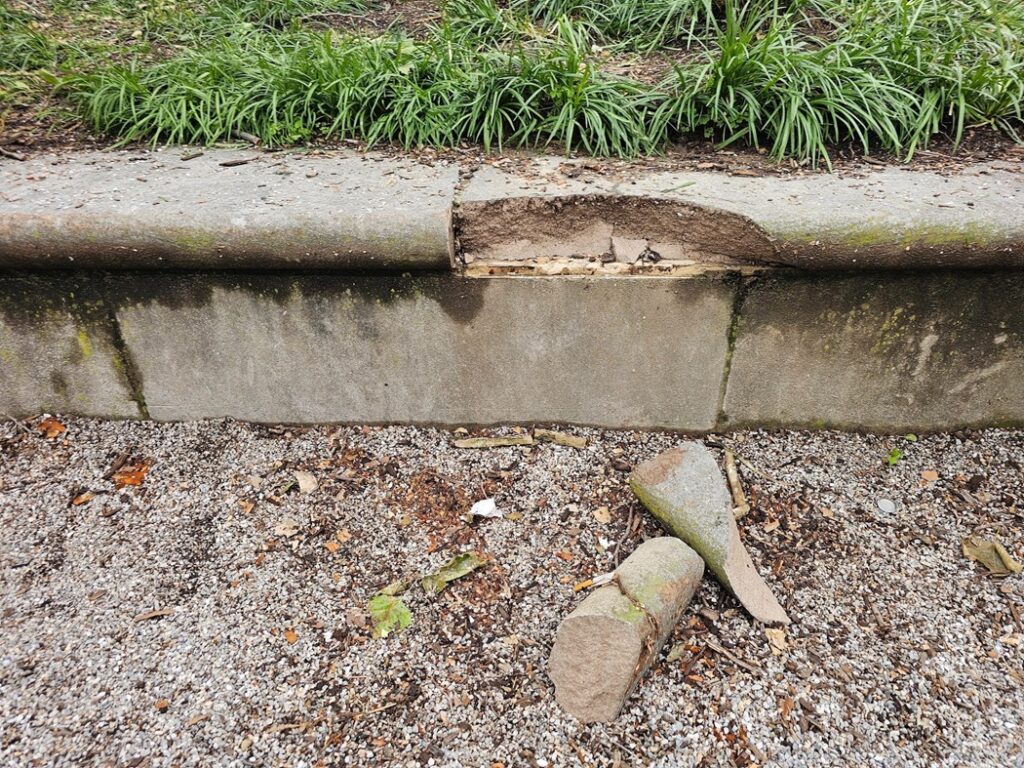
This installation shows a basic or simple retaining wall. The capstone on top of that retaining wall works like a sill. It’s also used as a bit of a ledge that can double as a bench or seating area along the edge of a park. There is a bullnose carved into the thick solid sandstone. When you look closely though there’s this particular detail that stands out. The outer surface of the stone has a grayish color but the inside of the stone, where it was broken away, is like a cross section. That cross sectional area shows a tan or light red color. Anyone that looks at this, who is interested in either geology or historic masonry restoration or architecture, should wonder what makes the difference between the surface area, where it’s been exposed for decades, and the interior of the stone. These two different areas or faces of the stone are made up of the same materials, ostensibly, but they are different colors for a reason. The grayish color exposed on the outside of the stone isn’t from an application of paint or stain. It’s from natural chemical weathering. That weathering caused a chemical reaction.
To understand that reaction, it’s first important to understand the composition of this particular stone.
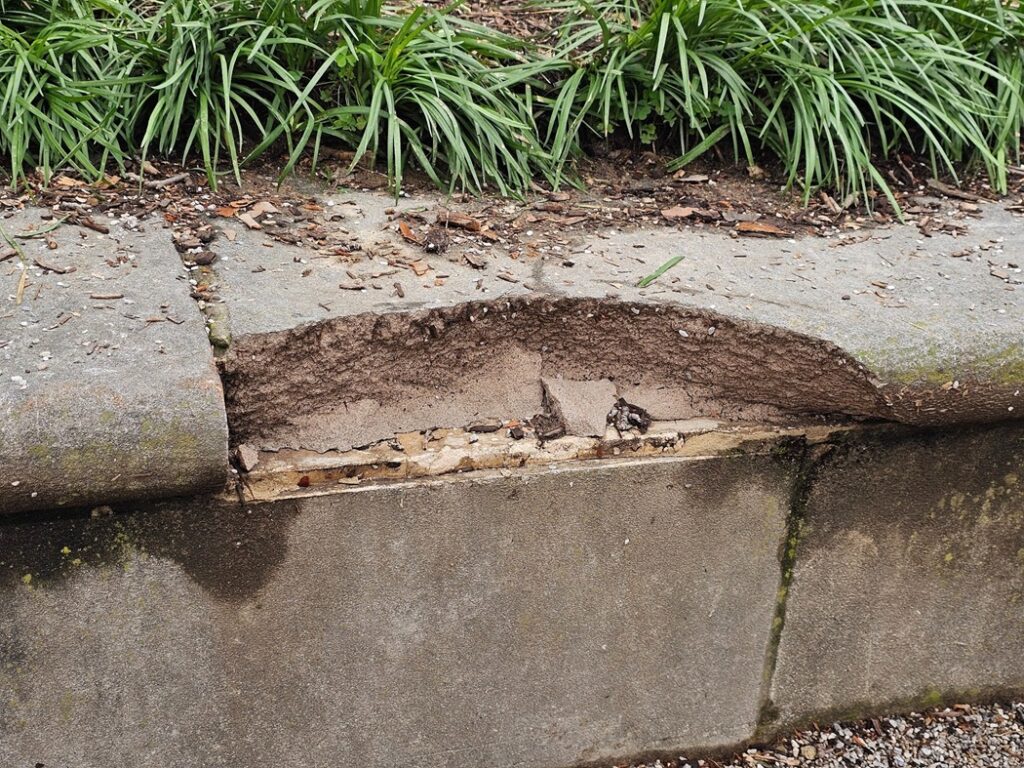
This happens to be a sandstone. Sandstone is similar to granite and limestones that we see so often used in historic construction. Sandstone is a little bit weaker though in some ways. Granite has extremely high resistance to breakage. But granite has an inordinately high compressive strength resistance. Sandstone isn’t strong in that way. Sandstone is a bit easier to cut and mold. Sandstone will also deteriorate faster than granite in certain methods or drivers of deterioration.
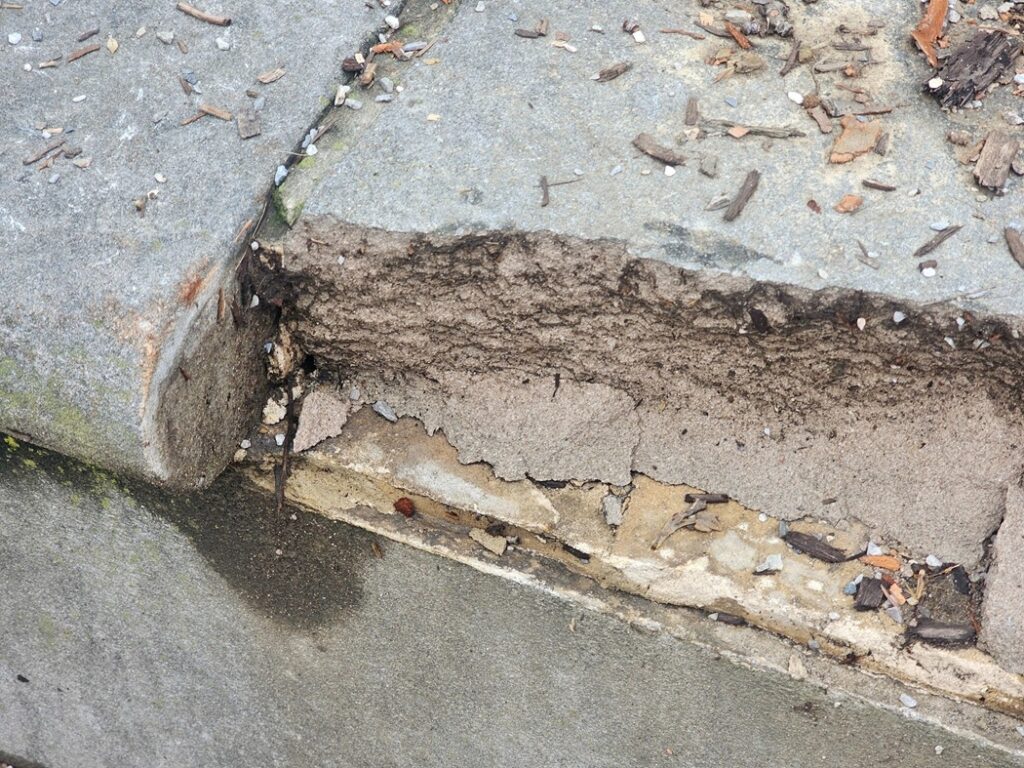
In this coming week, we’ll take a look at some close-up views of the stone from this particular point of breakage.
To properly maintain, repair, and care for these historic buildings, a knowledge, interest and understanding of historic building principles is required. Here in Washington DC, historic masonry buildings are extremely expensive and the amount of financial loss caused by improper repointing and low quality construction is staggering. However, in addition to the direct financial value of the property, there is also a cultural loss when historic buildings are damaged. By comparison, consider neighboring poor cities, when historic buildings are damaged, it’s not just the loss of value to the property owner, there’s also a loss to all inhabitants and visitors of a city, present and future, who care about architecture, history, and culture.
We encourage all of our clients, and all readers of this article and to our blog in general, to prioritize the historic built environment of Washington DC and neighborhoods such as Capitol Hill, Dupont Circle, and Georgetown and become educated on on the difference between proper historic preservation versus improper work which leads to significant damage to the historic fabric of a building.
From a conservation and preservation perspective, several approaches can be taken to improve conditions related to deteriorated historic brick masonry. Primarily, lime mortar brick joints and low temperature fired soft red clay bricks should be inspected and checked on a routine maintenance schedule, either seasonally or at least annually. If brick masonry is kept in good condition, the life of embedded wood elements can be significantly extended. Hire a professional contractor which specializes, understands and appreciates historic construction elements and buildings.
You can learn a lot more on our blog. Feel free to check it out. If you have questions about the historic masonry of your building in Washington DC, fill out the webform and drop us a line. We will be in touch if we can help.